UAE's oil exports efficiently back to pre-war levels, says TankersTrackers
- Last updated: September 2, 2026 | 19:25


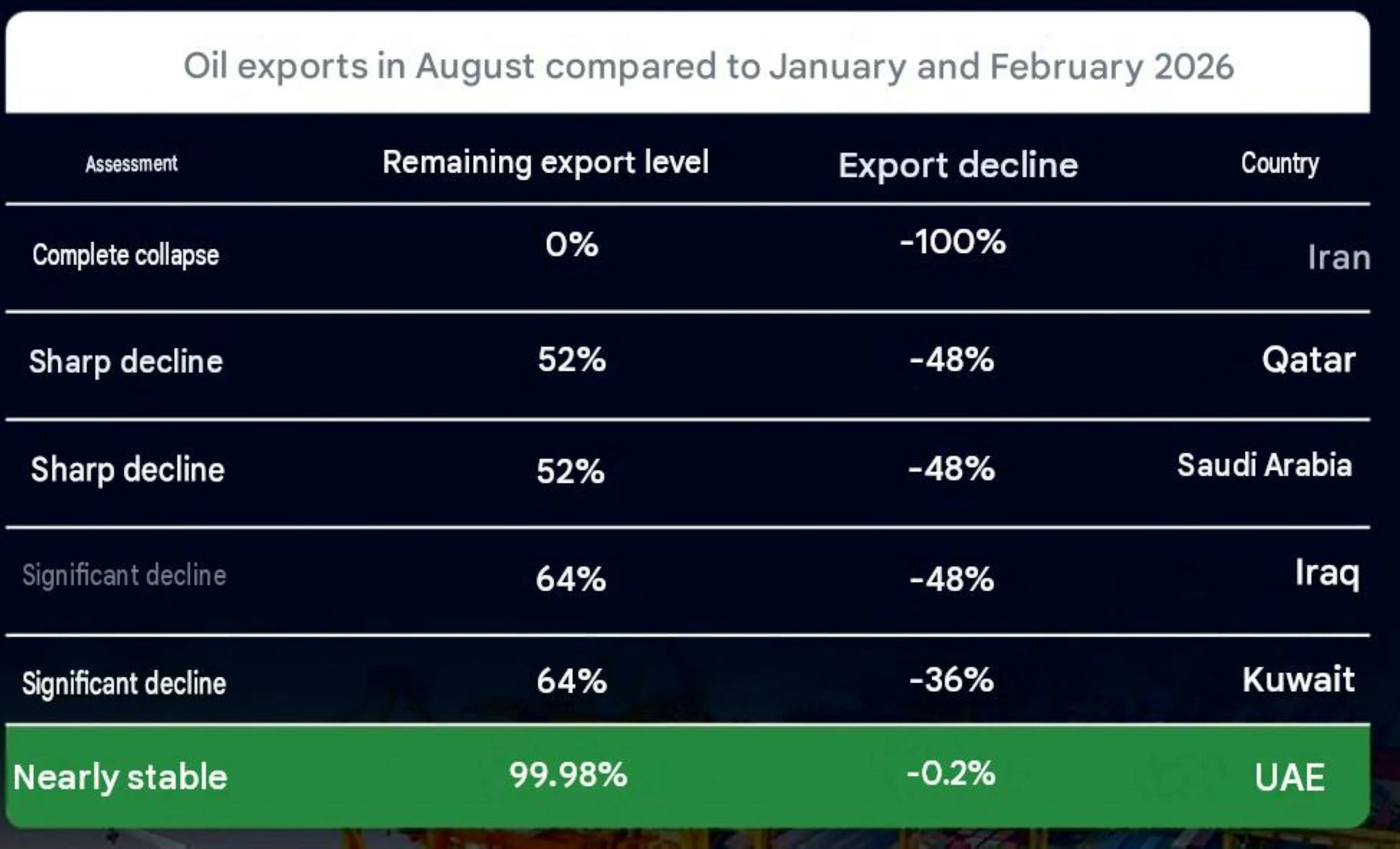
Data and analysis from TankerTrackers, a company that specialises in monitoring crude oil shipments worldwide, reveal that six months into the regional conflict, the UAE successfully maintained its crude oil exports at levels nearly matching those before the war. This highlights the resilience of the UAE's export system and its capacity to navigate disruptions in regional shipping routes.
The information shows that UAE crude exports declined by a mere 0.02% compared to prior levels, effectively maintaining its full export capacity. This comes at a time when major oil producers in the region saw varying degrees of disruption in their oil flows.
This achievement places the UAE among the most resilient countries in the region. According to the American company's data, Iran almost completely lost its crude exports following its conflict with the United States and Israel, experiencing a 100% drop. Meanwhile, Iraq and Kuwait each managed to recover about two-thirds of their pre-war exports, reflecting a 36% decrease each. On the other hand, Saudi Arabia saw a reduction of about 48% in its oil exports.
A Network Beyond Hormuz
The company asserts that the UAE's strength lies in a comprehensive network of diverse logistics and commercial capacities developed well before the war began. Fujairah plays a crucial role in this network, serving as a direct link to the Gulf of Oman and Asian markets, thus avoiding the traditional path through the Strait of Hormuz.
This network encompasses pipelines that bypass the strait, numerous ports, ship-to-ship operations, expansive storage facilities, shipping versatility, and sophisticated trade arrangements.
The analysis suggests that these multiple components empower the UAE to redirect oil shipments if one export route is compromised, rather than depending on a single path to convey crude oil from production sites to international markets.