Iran suspends commitments under Islamabad MoU after 'US violations'
- Last updated: July 18, 2026 | 18:59


The United States and Iran exchanged strikes aimed at infrastructure and military targets on Saturday as an Iranian negotiator said Tehran had suspended its commitments under the interim deal with the US - snapping another fragile thread as the war shows no end in sight.
The US has violated its commitments under the deal that was signed about a month ago and now Iran is "no longer implementing them,” Kazem Gharibabadi, Iran’s deputy foreign minister, told state TV. There was no new word on mediation efforts.
"We have also suspended our commitments, we are not implementing them, and we are busy defending the country," Gharibabadi added.
Meanwhile, Iran's Health Ministry said that 50 people were killed and over 500 others injured in US strikes since June 27.
"Among those killed were five women and two children and teenagers under 18," Hossein Kermanpour, head of the Health Ministry’s Public Relations and Information Centre, said on X.
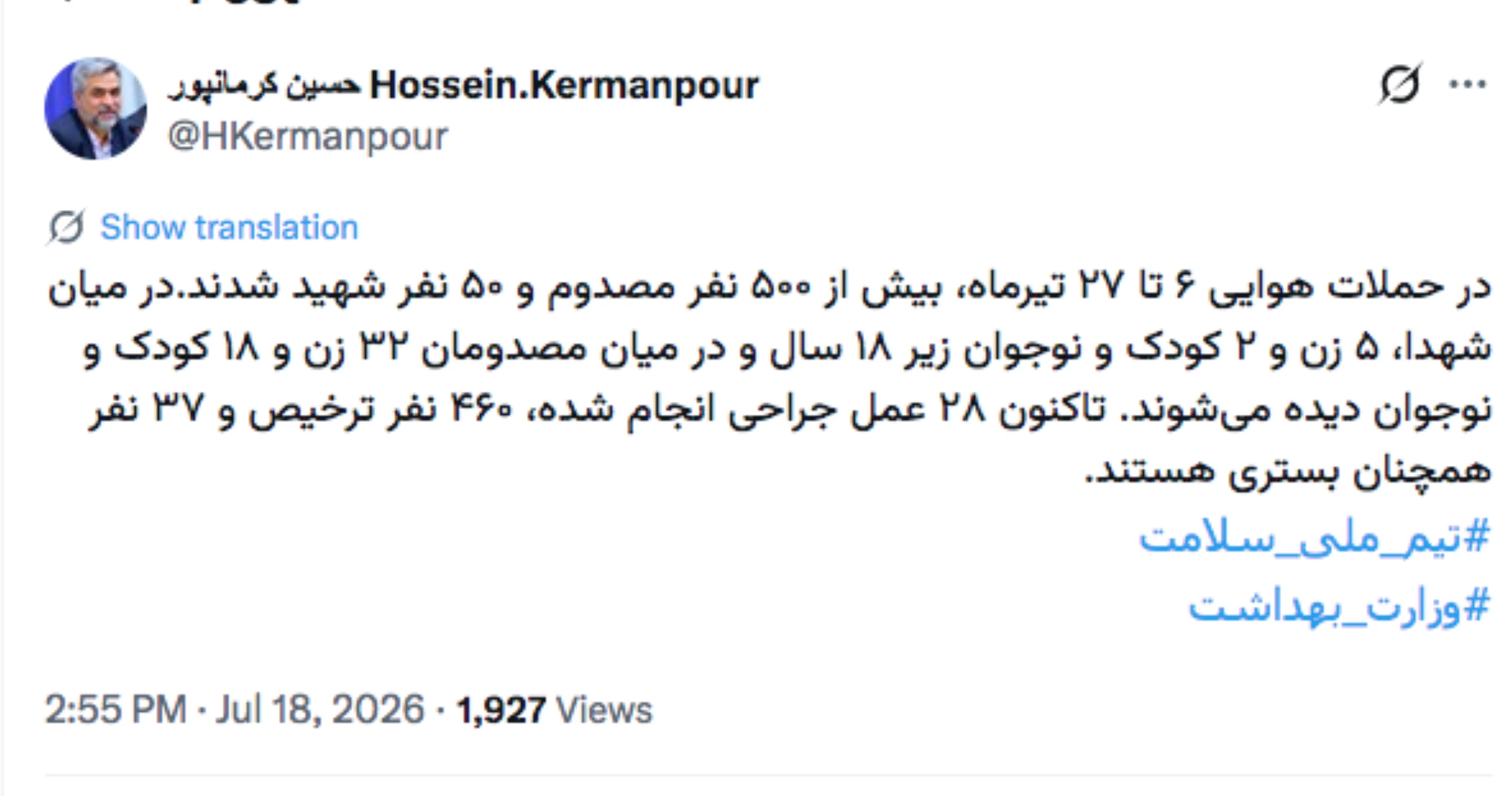
Those wounded included 32 women, as well as 18 children and teenagers, Kermanpour added.
Meanwhile, Pakistan's Deputy Prime Minister and Foreign Minister Ishaq Dar has underscored the need for de-escalation in the Middle East and the importance of upholding the commitments in the Islamabad Memorandum of Understanding in a phone call with Kuwaiti Foreign Minister Sheikh Jarrah Jaber Al Ahmad Al Sabah, the Foreign Office (FO) says.
In a post on X, it says that the pair discussed the latest developments in the region, with Jarrah expressing Kuwait’s serious concerns about continued attacks on its territory, hopeful that “restraint would be exercised by all sides and that the Islamabad MoU would be fully implemented.”
“Foreign Minister Sheikh Jarrah also appreciated Pakistan’s constructive and mediatory role in promoting dialogue and regional stability,” the FO adds.
“The Deputy Prime Minister/Foreign Minister underscored the urgent need for de-escalation, stressed the importance of respecting the sovereignty and territorial integrity of all states, and emphasised that maintaining regional peace and security must remain the foremost priority.”

According to the post, Dar also underlined the importance of upholding ceasefire commitments under the MoU and avoiding any action that could further escalate tensions.
The battle over the Strait of Hormuz intensified in a conflict increasingly focused on control of the essential waterway that previously carried a fifth of the world's crude oil. The widening strikes threatened civilians and services to them, including desalination plants for drinking water, while the global economy again was on alert.
The US Central Command said early on Saturday that its seventh straight night of strikes hit "surveillance sites, military logistics infrastructure, underground weapons storage, and maritime capabilities.”
The most significant damage from Iranian strikes on Saturday occurred in Kuwait, where a water desalination plant and an oil facility were hit, according to the Kuwait authorities and the Kuwait Petroleum Corporation. Both declined to provide locations.
The strikes injured several people at the oil facility and caused a fire at the desalination plant, forcing several power generation units offline. It was the second attack against a desalination plant in two days in the tiny desert nation that depends on desalination for 90% of its drinking water.
Several firefighters and a worker were injured while battling two other blazes sparked by Iranian strikes, according to the Kuwait Fire Force. Kuwait briefly closed its airspace due to missile threats, and Kuwait Airways said it was rescheduling most flights to and from the capital.
Meanwhile, Iraq said it shot down attack drones over the city of Irbil. Jordan’s state-run Petra news agency said the kingdom’s air defense systems had downed Iranian missiles, while air sirens sounded multiple times in Bahrain throughout the day and in Saudi Arabia in the morning, according to their governments.
US airstrikes hit an electricity and desalination plant in Iran’s southern Hormozgan province, Iranian state TV reported. IRNA said the Bonji desalination plant was destroyed, cutting off water supplies to about 10,000 people, and that a desalination plant on strategic Qeshm Island inside the strait was damaged.