Wreckage of K2 Airways cargo plane found off Pakistan's coast as search continues for 5 missing crew
- Last updated: July 8, 2026 | 18:47


Civilian and navy searchers off Pakistan's coast on Wednesday located and recovered wreckage of a cargo plane that disappeared while approaching the southern port of Karachi, and a search continues for five missing crew members, officials said.
The aircraft operated by the private carrier K2 Airways had departed from Sharjah and reported a navigational system problem before losing contact with air traffic control late on Tuesday.
The Pakistani navy and civilian teams in planes and ships found the wreckage after about 12 hours of searching in the Arabian Sea, Pakistan's Airports Authority (PAA) said in a post on X. The search continued for five missing people who were aboard the aircraft.

Three officials familiar with the search operation, who spoke on the condition of anonymity because of the sensitive nature of the incident, said the vast search area in the Arabian Sea and rough monsoon seas were posing significant challenges to the search-and-rescue operation.
Prime Minister Shahbaz Sharif expressed sympathy with the families of the five crew members, according to a statement from his office, and directed the government to deploy all available resources for the search effort.
In a statement, K2 Airways identified the missing crew as Capt. Muhammad Rizwan Idris, First Officer Faisal Jatoi, flight engineers Muhammad Hamid and Muhammad Arif Siddiqui, and aircraft loader Muhammad Taufiq Khan.
"We continue to pray earnestly for the safety of our colleagues," it said.
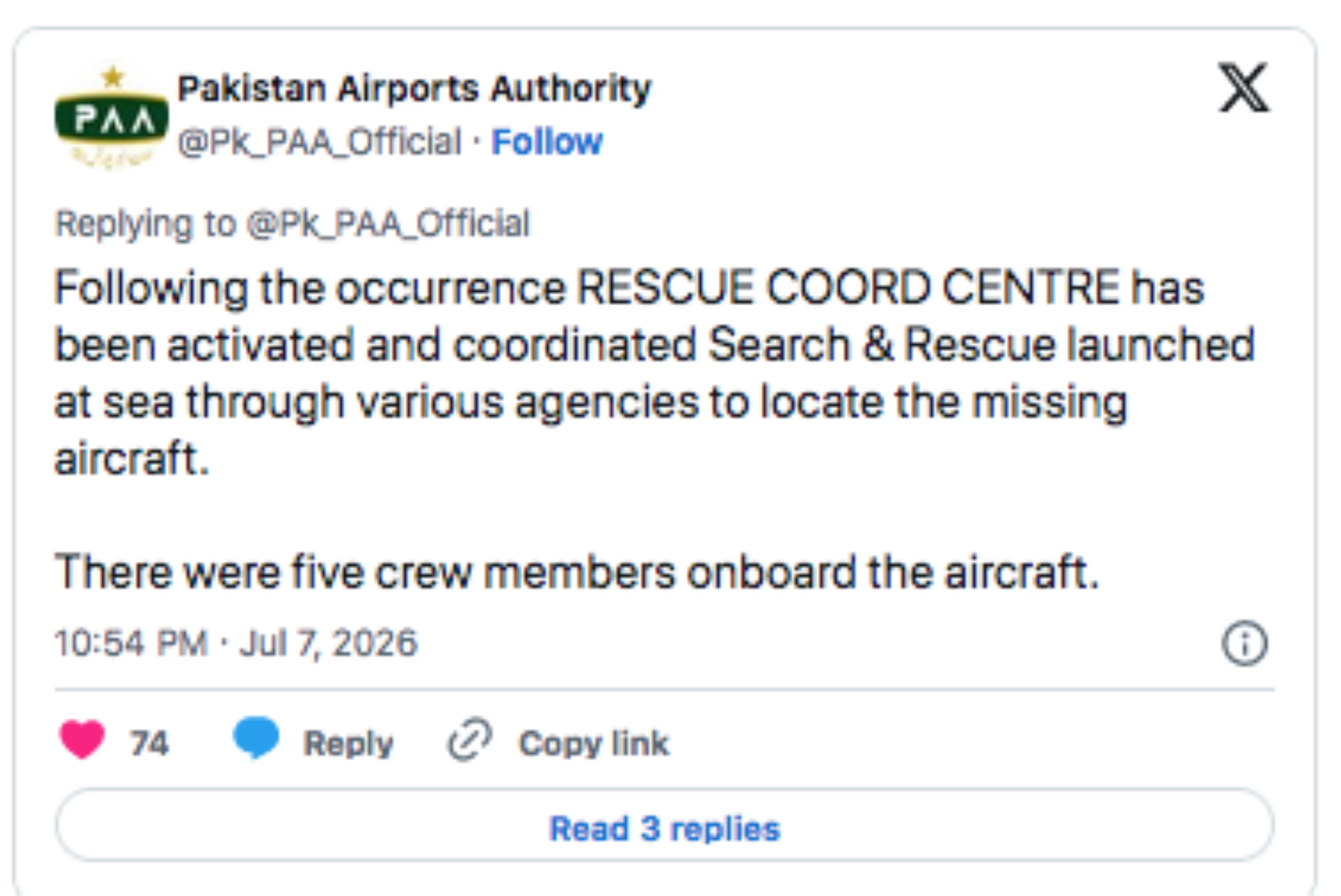
Pakistan's Airports Authority said earlier on X that radar data showed the aircraft making a sharp change in heading and rapidly descending before radar and radio contact were lost at about 9:21pm, approximately 155 nautical miles (287 kilometres, 178 miles) west of Karachi.
Aviation expert Imran Aslam told local broadcaster ARY News late on Tuesday that it remained unclear what caused the aircraft to disappear from radar. He said that even if an aircraft suffered an engine failure, it would normally continue gliding rather than plunge suddenly.
He said the exact cause would become clear only after investigators gathered more evidence.
The plane reported a navigational system issue at 9:18pm Pakistan Standard Time (1618 GMT) while flying towards Karachi, the airports authority said.
Local air traffic control tried to guide it but three minutes later radar systems showed the plane descending rapidly and communication was lost, the authority said. The flight was about 155 nautical miles (287 km) west of Karachi at the time, according to the statement.
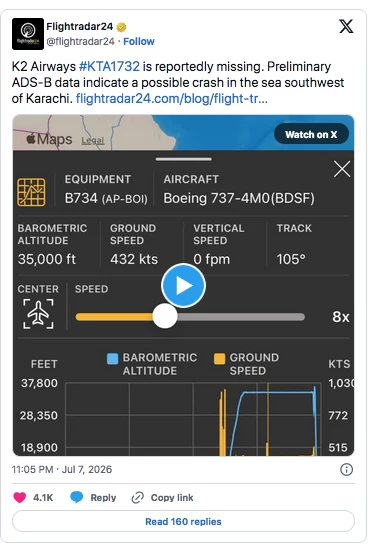
The final minutes of Flightradar24's tracking data appeared chaotic, showing the plane plunging about 5,000 feet in less than a minute before soaring about 6,000 feet in 30 seconds and then entering a catastrophic dive from 36,550 feet.
The last transmitted data point placed the aircraft at 1,100 feet above sea level, with a vertical rate of minus 22,400 feet per minute - about 400 kilometres per hour - an extremely steep and abnormal rate of descent.
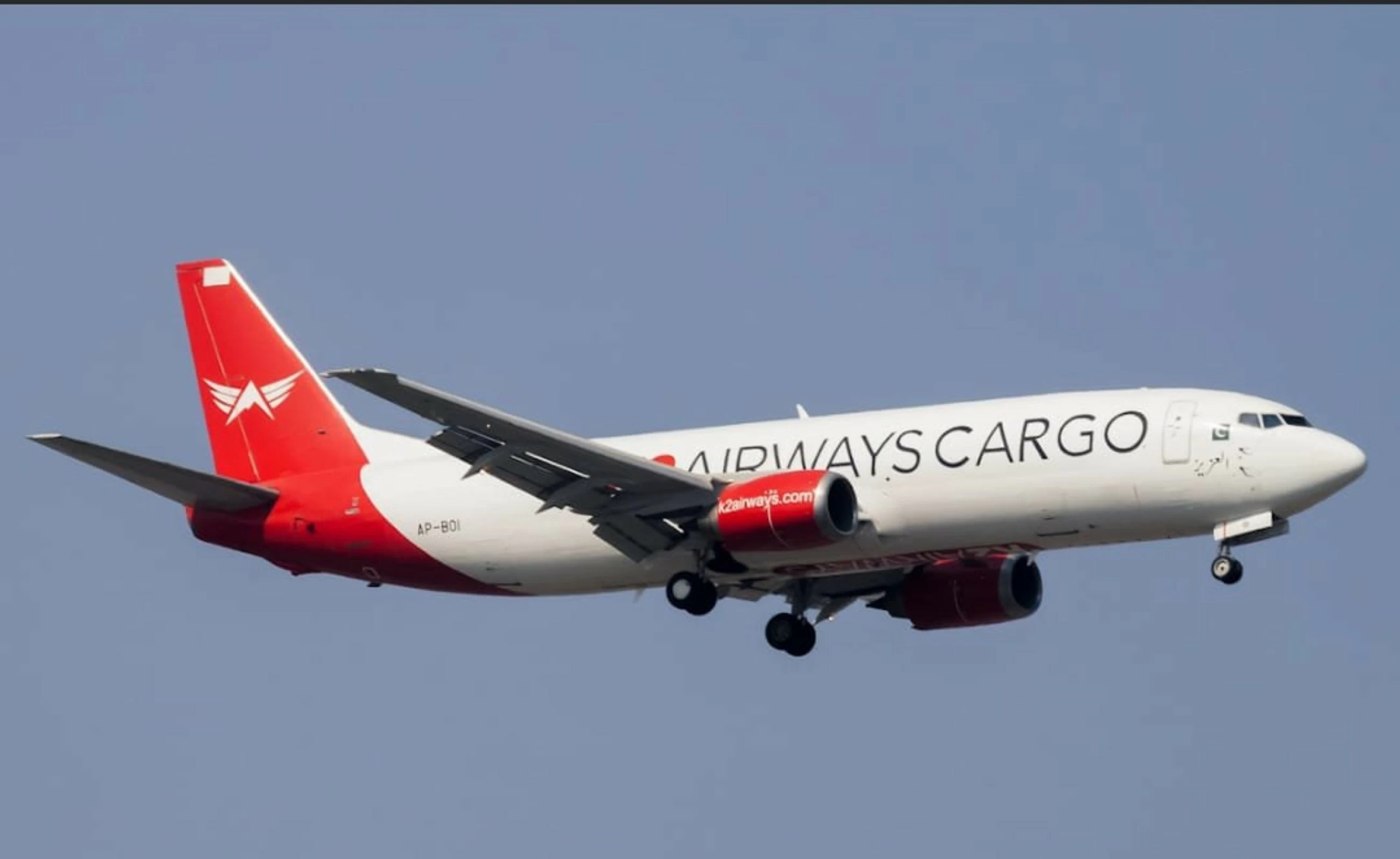
The missing aircraft is one of Boeing's decades-old 737-400s, two generations older than the 737 MAX that has been involved in a safety crisis. It uses engines made by CFM International, jointly owned by GE Aerospace and France's Safran.
The 737-400 was first delivered as a passenger plane to Russia's Aeroflot in 1999 and was converted to a freighter in 2012, according to Flightradar24. It is K2 Airways' only aircraft and entered service with the carrier in 2024. Its previous flight was on June 28, according to Flightradar24 data.
The incident would be Pakistan's first fatal crash since 2020, when a Pakistan International Airlines Airbus A320 came down short of the runway in Karachi, killing 97 people.
Reuters / AP