Pakistan PM says US and Iran expected to sign initial deal within 24 hours
- Last updated: June 13, 2026 | 15:37


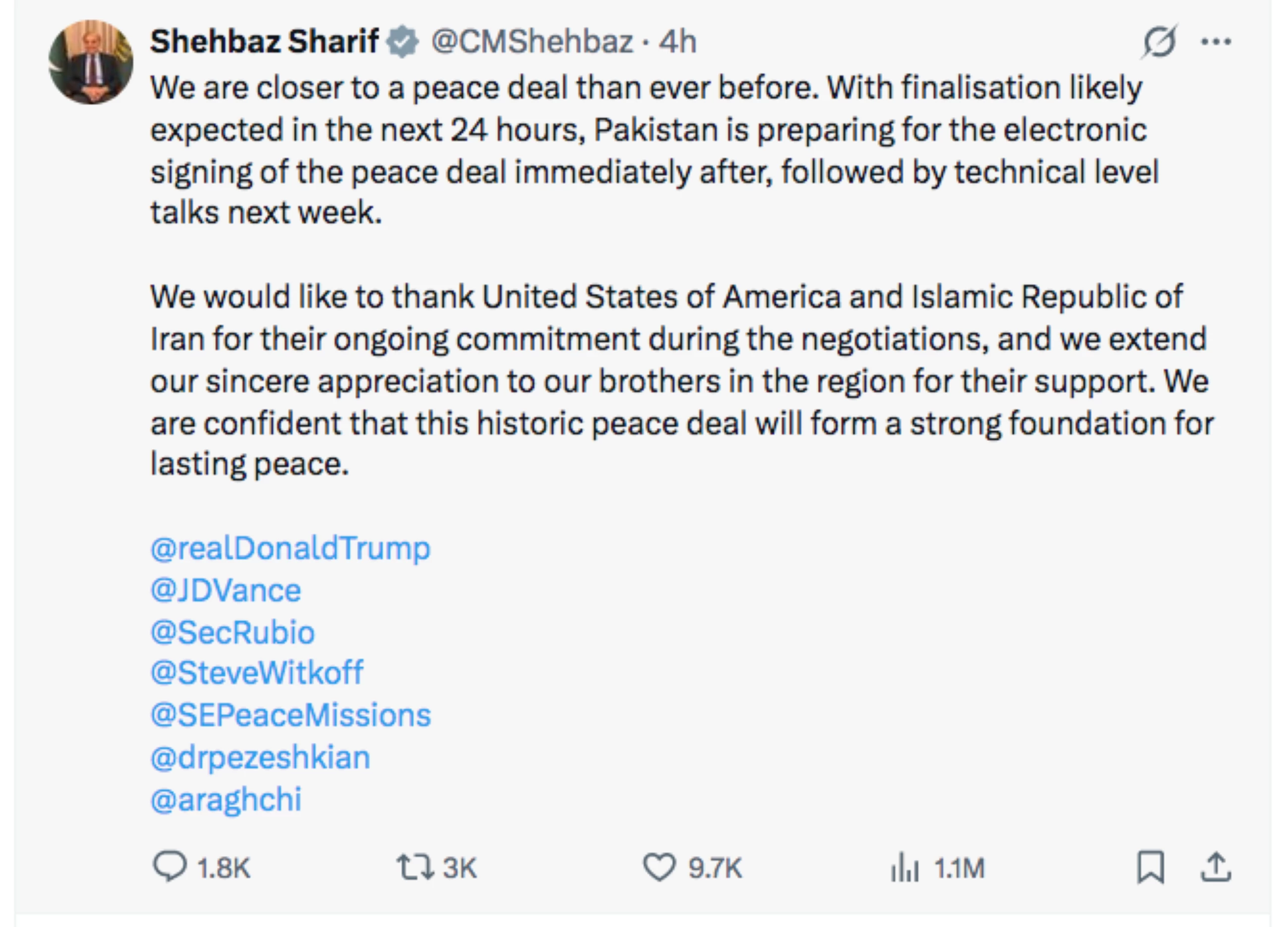
Pakistani Prime Minister Shahbaz Sharif said on Saturday that the peace deal between Iran and the United States is expected to be finalised in the next 24 hours and that "we are closer to a peace deal than ever before."
In a post on X, he wrote that Pakistan is preparing for the electronic signing of the peace deal and technical-level talks would follow afterwards.
"We would like to thank the United States of America and Islamic Republic of Iran for their ongoing commitment during the negotiations, and we extend our sincere appreciation to our brothers in the region for their support. We are confident that this historic peace deal will form a strong foundation for lasting peace."
The US and Iran had signalled on Friday that an agreement to end their war was close, with a senior US administration official saying both sides had agreed on a text and that Washington expected to sign an initial deal in coming days.
Iran's Foreign Minister Abbas Araghchi had written in a social media post on Friday that "The Islamabad Memorandum of Understanding has never been closer," referring to the Pakistani capital that previously hosted talks.
Araqchi said that while changes in the deal were still possible, the tentative agreement showed his country had emerged stronger from the conflict. "Iran is the winner of the war with the US," he said on state television on Friday.
Hours after those remarks, US forces shot down multiple Iranian one-way attack drones heading toward the Strait of Hormuz, a source familiar with the matter told Reuters.
The source, who spoke on condition of anonymity, said the drones had posed a threat to commercial traffic.
US Central Command later confirmed the action and said the waterway was open. The proposed memorandum of understanding calls for reopening the strait and lifting the US naval blockade on Iranian ports, sources on all sides of the talks said.
Negotiations over Iran's nuclear programme — US President Donald Trump's stated rationale for starting the war - would take place afterwards. A U.S. official, speaking on condition of anonymity, told reporters on Friday that the deal met Trump's core objectives and put negotiations "in a very, very good place."
In the meantime, while speaking in the National Assembly, PM Shahbaz affirmed the government's commitment to contribute to the development of all provinces.
He noted that he would not give a "detailed response" to the criticism voiced by opposition leader Mehmood Khan Achakzai, but at an "appropriate time."
Earlier, Achakzai had spoken mostly on the country's law and order situation and had also criticised the government's decision to freeze the development allocations for the provinces, contending that it would hit their health and social sectors.
Noting that all MPs were immensely respectable and the legislature was akin to a "house," Shahbaz said that each one can have their politics and vision, but one thing that this House will always attest to is that we are here if Pakistan is.
"There is no difference of opinion on this," he affirmed, recalling Achakzai's assertion that the provinces had the right to their financial resources.
Recalling various projects that had been carried out in Balochistan, the prime minister said, "You did not demand this, nor did someone else. But as the prime minister of Pakistan, it is my responsibility to do my best so that all four provinces are at the same level in the race to progress. If this will be our collective desire and practical attempt, then this is among the possibilities."
The premier highlighted the "shares of the people of Balochistan" in the Reko Diq project and the 2010 National Finance Commission (NFC) Award in which the province's share was doubled. He stated that he was saying this not to rub it in, but just to remind that even a house cannot function without financial and social justice."
He also recalled the distribution of solar panels to the farmers of Balochistan, adding, "This is a tale of brotherhood." He went on to mention a road being constructed from Chaman to Gwadar.