No AI algorithm can make war morally acceptable, says Pope Leo
- Last updated: May 25, 2026 | 15:24


Pope Leo XIV called on Monday for the "disarming" of artificial intelligence in his long-awaited manifesto on the rapidly developing technology, and warned of "new forms of slavery" behind its rise.
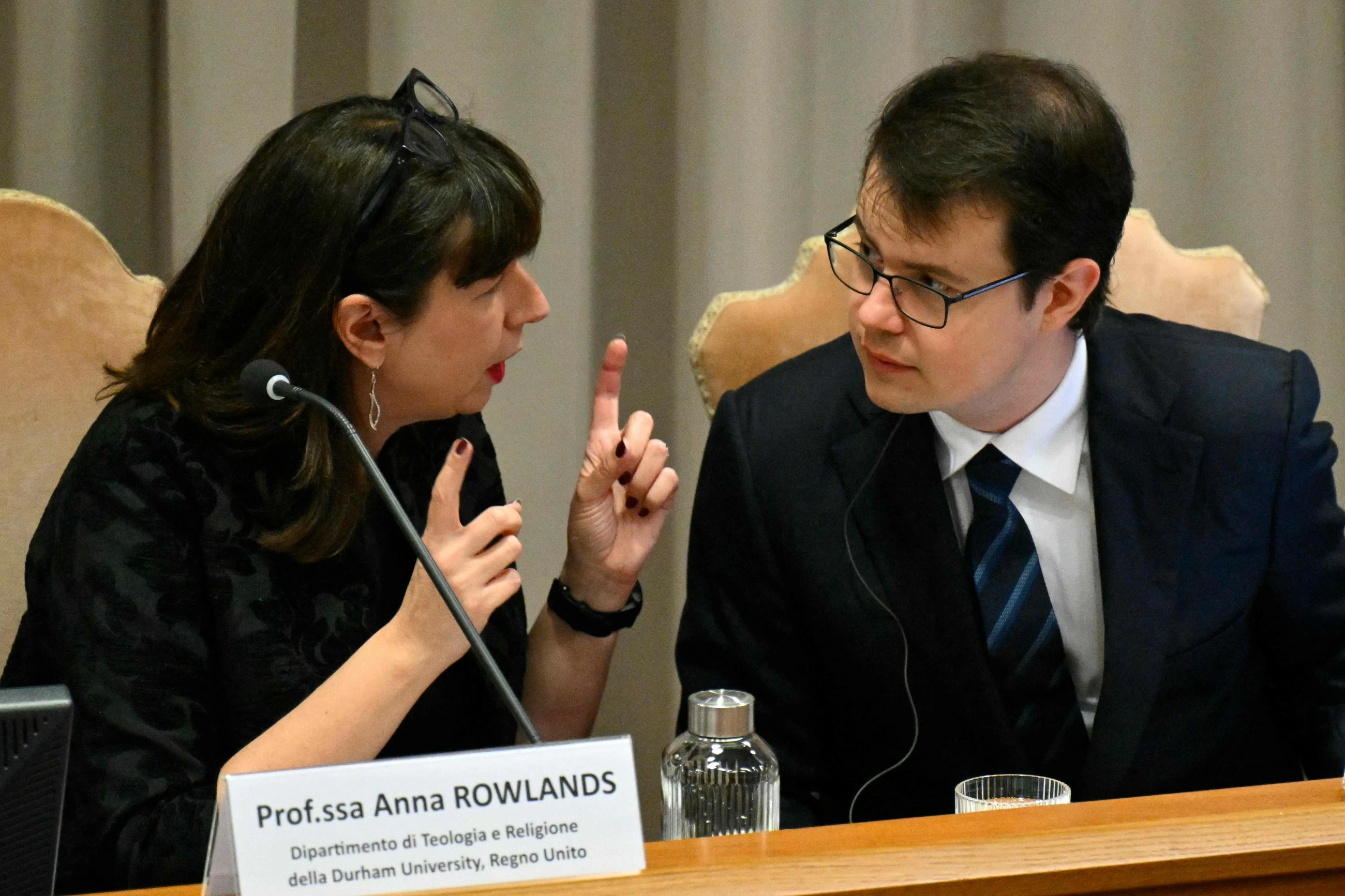
The "just war" theory – espoused recently by the Trump administration – was "outdated", Leo wrote in his first encyclical, which he presented in person at the Vatican, alongside AI experts including the co-founder of US giant Anthropic.
The first US Pope, who has clashed with the White House over the Iran war and its use of religion to justify conflict, sounded the alarm over AI-directed weaponry, saying it was "not permissible to entrust lethal" decisions to tech.
American giant Anthropic, which has staked its position as an ethical AI company, is embroiled in a legal battle with the US military after opposing the use of its technology for lethal autonomous warfare or mass surveillance.
Without naming US President Donald Trump, Leo stressed it was "important to reaffirm that the 'just war' theory, which has all too often been used to justify any kind of war, is now outdated".
"No algorithm can make war morally acceptable," he added.
Leo says that disinformation "found a powerful amplifier" with AI through the ability to "manipulate content, images and videos," which exposes people to "biased or misleading perspectives." The Pontiff said democracy is weakened when pragmatism, that is "what appears useful effective," substitutes for truth. "Indifference to the truth leads, slowly but surely, to a descent to totalitarianism," Leo wrote.
Leo said that those who control digital platforms, including social media, have a power that "should be constantly guided by the pursuit of truth or respect for human dignity." The internet should be seen as "a setting in which inner freedom and critical thought can mature,'' and not "an instrument of excessive distraction, homogenisation or dominance." The backdrop is that communication not only transmits information but creates culture.
Leo said the workplace must be governed by "the protection of employment opportunities and the irreplaceable role of the individual." He warned that "the pursuit of greater profits cannot justify choices that systematically sacrifice jobs, because the human person is an end, not a means, and the economic order must remain subordinate to human dignity and the common good." Leo also said governments must foster conditions that favour employment "since it is a primary good for families and for societies."
Leo said that AI "can only bring conflict about more quickly and render it more impersonal." He called for concrete criteria when making a decision to strike. That includes an identifiable chain of responsibility applying also to "those who design, train, authorise and employ technology," and measures, so that target selection takes into account the difference between combatants and noncombatants, and the impact on defenceless populations. Non-negotiable requirements include guarantees of accountability and that deployment of lethal force cannot be automated. Leo also called for a shared international framework "to curb the technological arms race and ensure robust protection for civilians."
Leo noted that the world's wealth "is increasingly concentrated in fewer hands, widening inequalities." In the age of AI and robotics, it is no longer possible to rely solely on the "invisible hand' of the market," Leo wrote, urging politicians to orient policies toward "the common good" and to promote "dignified work, social inclusion and an equitable distribution of the benefits of innovation."
Leo underlined the role of digital networks – including online platforms, messaging systems, anonymous payment methods – in human trafficking, which he said "must be recognised as a contemporary form of slavery." He warned that failing to respond to or tolerating these practices risks complicity in "today's sins, which are akin to those of the past when slavery was being concealed and justified."
Leo called for an alliance among policymakers, educational institutions and families to help navigate the "culture of immediacy and hyperstimulation" created by digital media. He also highlighted how AI amplifies the danger of predation on young people, and warned against having personal mobile devices at too young an age. "Online phenomena such as grooming, blackmail and the sexual exploitation of minors are not uncommon, and are made more insidious by the use of fake profiles, algorithms that facilitate dangerous contact, and AI tools capable of manipulating images and videos," the Pope wrote.
Disarming AI
AI could be worth up to $4.8 trillion by 2033, a 25-fold increase in a decade, while concentrating its profits in the hands of a limited few, according to the United Nations.
"Disarming AI means freeing it from the mentality of 'armed' competition," the Pope wrote in "Magnifica Humanitas" (Magnificent Humanity), a bid to address the ethical and social challenges behind AI.
"To disarm does not mean rejecting technology, but preventing it from dominating humanity," Leo wrote.
AI should be "human-friendly", accessible to all and opened to discussion and debate, he added.
The head of the world's 1.4 billion Catholics has made the hot-button issue a cornerstone of his papacy by dedicating to it his first encyclical – a document which lays the basis for Church teaching and longer-term debate.
The manifesto references a range of cultural giants, from Greek philosopher Plato to Beethoven and his Ninth Symphony, even citing a character from JRR Tolkien's "The Lord of the Rings".
"Magnifica Humanitas" was signed on May 15, the 135th anniversary of a 1891 encyclical by Leo XIII which laid the foundations of the Church's social doctrine during the Industrial Revolution.
The release of the text follows several years of study by the Church on AI-related technologies.
As early as 2020, the Holy See launched the "Rome Appeal for an AI Ethic", which called for new technologies to respect human dignity.
Experts say "Magnifica Humanitas" could prove as influential as Pope Francis's "Laudato Si", a 2015 climate manifesto that triggered political and civic reactions worldwide.
Agence France-Presse