Police officers begin to move off after a march organised by Unite The Kingdom, in central London on Saturday. AFP
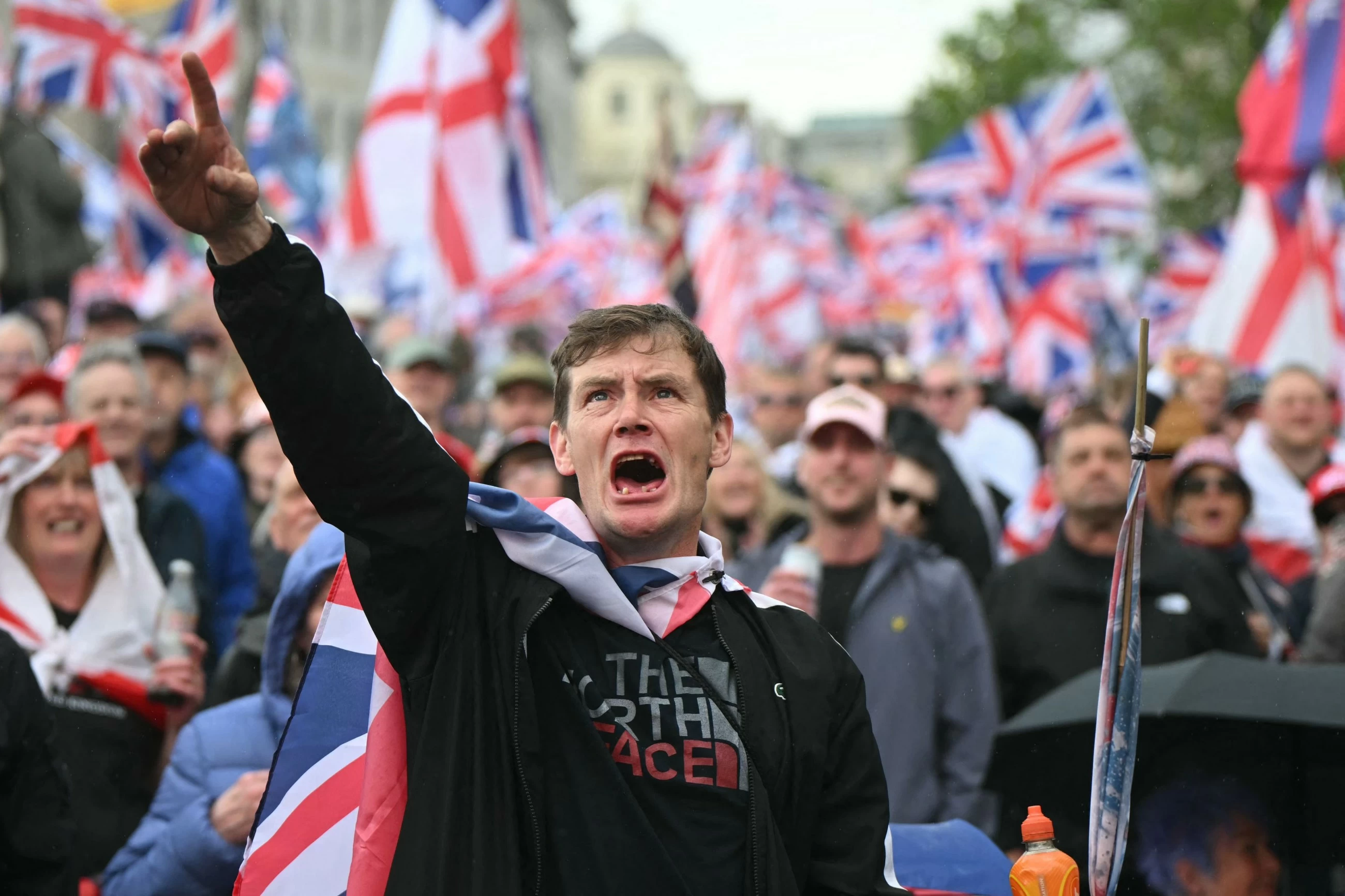
Protesters take part in a "Unite the Kingdom" rally organised by British anti-immigration activist Stephen Yaxley-Lennon, also known as Tommy Robinson, in London, Britain, on Saturday. Reuters
Tens of thousands of people marched through central London on Saturday in two separate protests — one against high levels of immigration and another in support of Palestinians.
Police deployed 4,000 officers, including reinforcements from outside the capital, and pledged “the most assertive possible use of our powers” in what they called their biggest public order operation in years.
By 1530 GMT, about four hours after both marches started, police said they had made 31 arrests for a range of offences and described both protests as “largely without significant incident.” They had earlier forecast turnout of at least 80,000.
The Met imposed conditions on Saturday’s two rallies in a bid to keep rival attendees apart, and for the first time organisers were made legally responsible for ensuring invited speakers did not break hate speech laws.
Prime Minister Keir Starmer warned on Friday that “anyone who sets out to wreak havoc on our streets, to intimidate or threaten anyone... can expect to face the full force of the law.” He accused the organisers of Robinson’s rally of “peddling hatred and division.”
Supporters of British far-right activist Tommy Robinson, real name Stephen Yaxley-Lennon, watch the speeches on screens after taking part in a march organised by Unite The Kingdom, in central London on Saturday. AFP
The march was organised by anti-Islam activist Stephen Yaxley-Lennon, known as Tommy Robinson. The government barred 11 people it described as “foreign far-right agitators” from entering Britain to address the protest.
Meanwhile, the government has blocked 11 “foreign far-right agitators” from entering Britain for Robinson’s rally.
A previous protest led by Robinson in September drew around 150,000 people, police said, and featured a video address by US tech billionaire Elon Musk. Scuffles left 26 officers injured, including four seriously.
On Saturday, Robinson supporters gathered in central London, waving mainly British and English flags.
“I think that too much migration — not migration, but too much migration — is causing a lot of problems, upsetting a delicate balance here,” said Allison Parr, who also criticised net-zero environmental policies.
Annual net migration approached 900,000 in 2022 and 2023, but fell back to around 200,000 last year after tighter work visa rules.
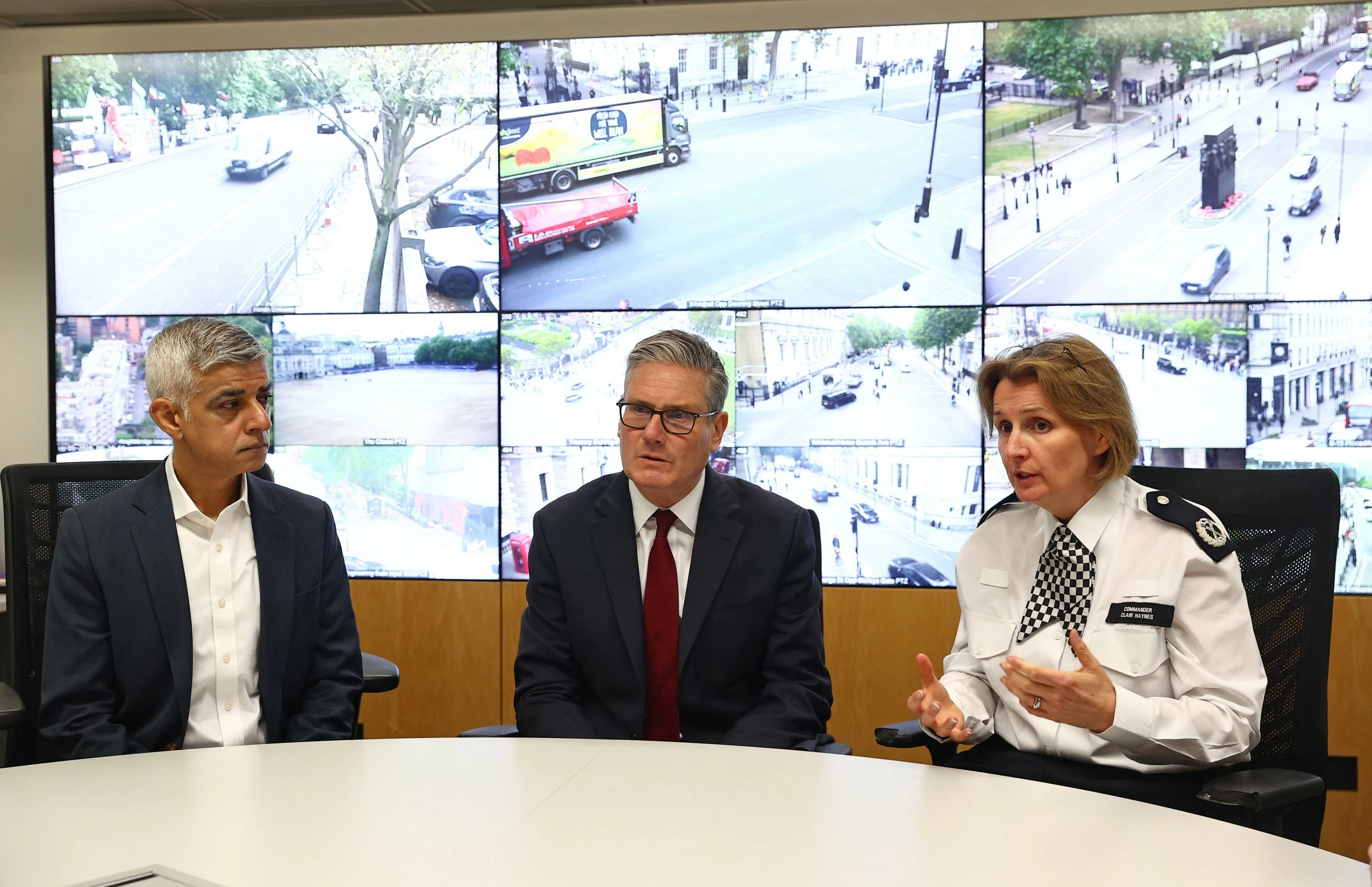
Britain's Prime Minister Keir Starmer (centre) sits with Mayor of London Sadiq Khan (left) and Police Commander Clair Haynes beneath screens showing images of Whitehall from CCTV cameras located across London, as he meets with Metropolitan police officers to discuss operational planning ahead of this weekend's planned protests, in the Lambeth area of London on Friday. AFP
Concern over immigration — including the arrival of asylum seekers on small boats — has weighed on Starmer’s popularity and boosted the right-wing Reform UK party, whose leader Nigel Farage has distanced himself from Robinson.
Some protesters chanted abuse about Starmer.
Nearby, demonstrators carrying Palestinian flags and placards calling for an end to the conflict in Gaza held a march to mark Nakba Day, commemorating Palestinians’ loss of land in the 1948 war that followed the creation of Israel. “Nakba” means catastrophe in Arabic.
“Israel, its behaviour is unjust beyond belief,” protester Sharon De-Wit said. “After the Holocaust etc, all you can do is wish the Jewish people all the best. But they won’t be able to live in peace until they allow the Palestinian people to form their own state.”
London has recently seen a spate of arson attacks on Jewish sites, and two Jewish men were stabbed last month in an incident being treated as terrorism.
Some protesters on Saturday chanted “Death to the IDF,” referring to the Israeli army — language that police previously said had been a reason for arrests when aimed at Jewish people.
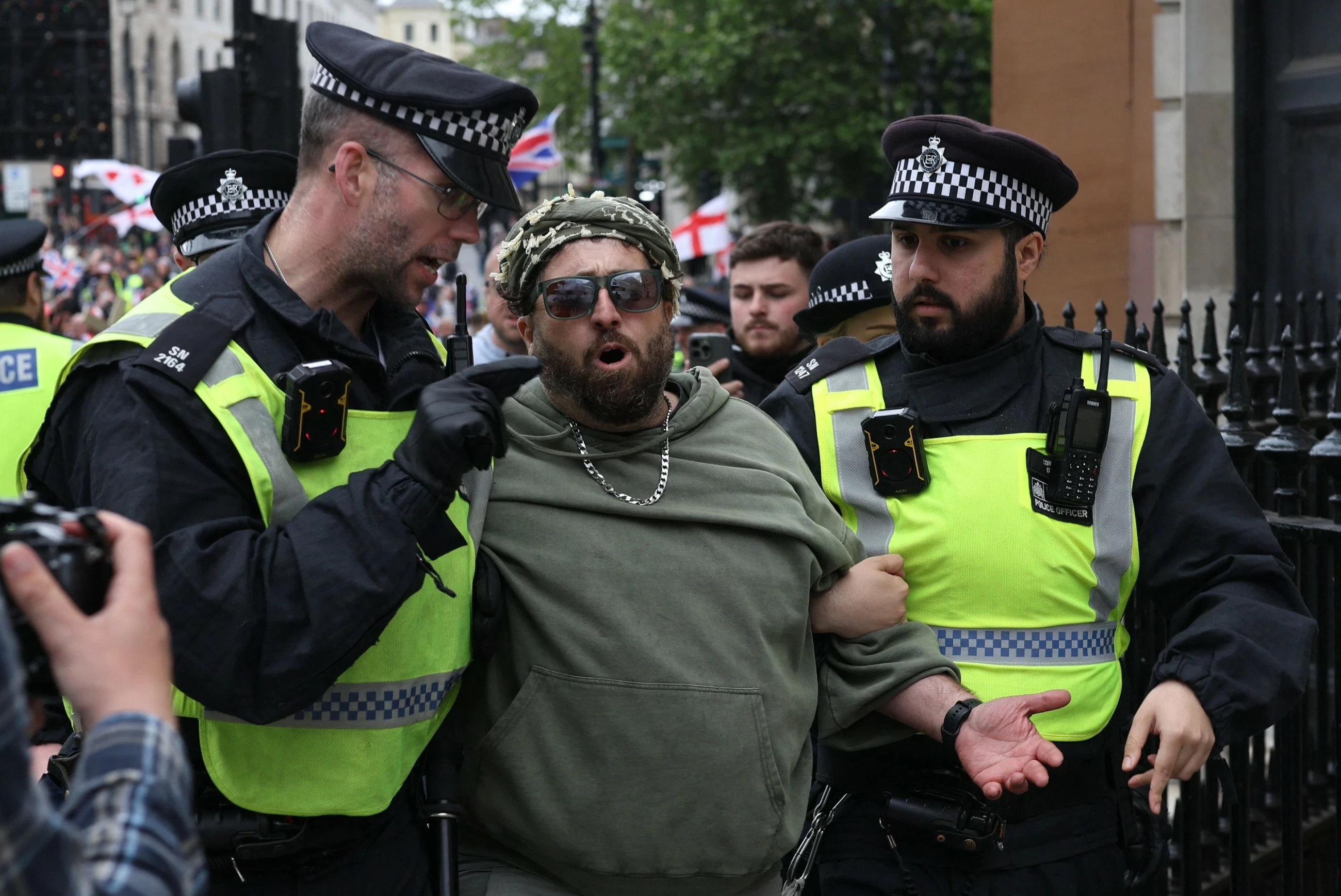
A protester from another march is taken away by police officers after coming to close to a march organised by Unite The Kingdom, in central London on Saturday. AFP
Earlier during the day, an Israeli airstrike on Gaza killed the chief of Hamas’ military wing, the most senior official from the Palestinian group killed by Israel since an October US-backed ceasefire agreement that was meant to halt fighting.
The Israeli military said on Saturday that Izz Al Din Al Haddad was killed in what it described as a precise strike on Gaza City on Friday. Israel has repeatedly carried out strikes on Gaza since the ceasefire started.
Hamas confirmed in a later statement that Haddad, who was born in 1970, was killed along with his wife and daughter. It described him as a central figure in directing combat operations and accused Israel of trying to achieve politically through killings what it had failed to achieve militarily.
At Al Aqsa Martyrs Mosque in central Gaza, a joint funeral was held on Saturday for Haddad, his wife and their 19-year-old daughter.
Israel carried out at least two attacks on Gaza on Friday, killing seven Palestinians, including three women and one child, according to local medics. A Palestinian source said Haddad was killed in an Israeli strike on an apartment building.