Trump warns Iranian 'fast-attack' ships breaching US blockade will be 'eliminated'
Last updated: April 13, 2026 | 19:15
NatoO allies refuse to join Donald Trump's Strait of Hormuz blockade.
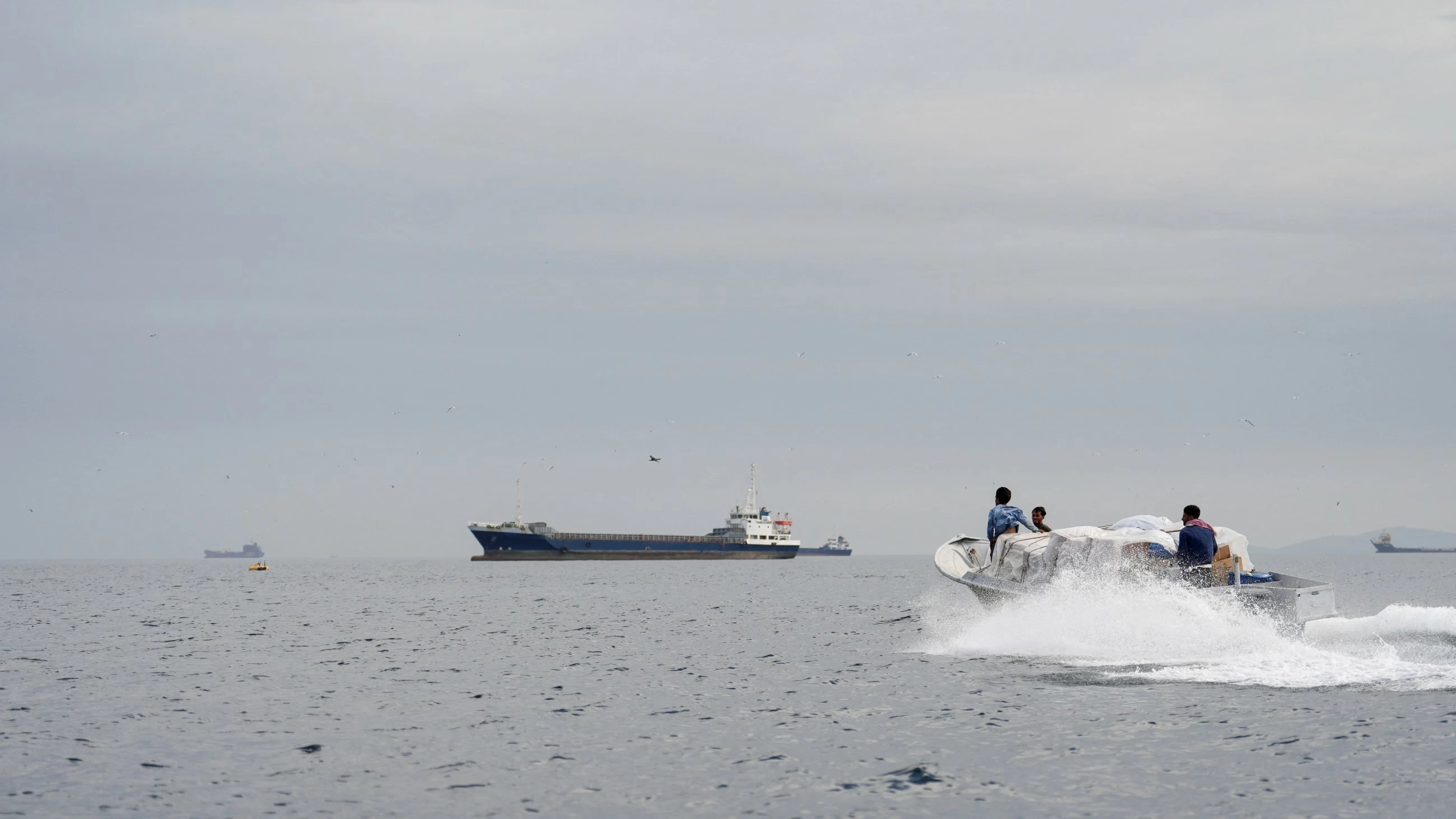
A ship is seen in the Persian Gulf off the coast of Sharjah the day after the failure of US-Iran peace talks on April 13, 2026. The failure of US-Iran peace talks has left the US President with several unpalatable options, as analysts say his order to blockade the strategic Strait of Hormuz could further complicate his next move on April 12, 2026. Any hopes that US Vice President would emerge from the marathon day of negotiations with top Iranian officials with a deal to end a war that has rippled across the Middle East were dashed when he left hosts Pakistan emptyhanded. (Photo by AFP)
A vessel at the Strait of Hormuz, off the coast of Oman’s Musandam province, April 12, 2026. REUTERS
President Donald Trump warned on Monday that any Iranian "fast-attack" ships that go near a US maritime blockade on Iran would be eliminated.
Trump made the threat shortly after the US blockade on vessels entering and departing Iran had been due to come into effect at 1400 GMT on Monday.
Describing Iran's navy as "completely obliterated" during the six-week-long war between the US and Iran, Trump posted on Truth Social: "What we have not hit are their small number of, what they call, 'fast attack ships,' because we did not consider them much of a threat."
"Warning: If any of these ships come anywhere close to our BLOCKADE, they will be immediately ELIMINATED, using the same system of kill that we use against the drug dealers on boats at Sea. It is quick and brutal," Trump wrote.
Vessels and a boat at the Strait of Hormuz, off the coast of Oman’s Musandam province. Reuters
Trump was referring to the dozens of US strikes carried out against suspected drug boats in the Caribbean and Pacific since September in a campaign that has killed at least 110 people.
Iran has effectively closed the Strait of Hormuz, cutting off a vital waterway that normally carries about a fifth of global oil and liquefied natural gas supplies, in retaliation for US-Israeli strikes.
Iran's conventional navy has largely been destroyed but Iran's Islamic Revolutionary Guard Corps still have plenty of options including fast-attack craft, mini submarines, mines and even jet skis packed with explosives, said Tom Sharpe, a retired Royal Navy commander, last month.
Britain and France refuse to join blockade
Nato allies including Britain and France said they would not be drawn into the conflict by taking part in the blockade, stressing instead the need to reopen the waterway, through which about one-fifth of the world's oil normally passes.
"We're not supporting the blockade," British Prime Minister Keir Starmer told the BBC. "My decision has been very clearly that whatever the pressure, and there's been some considerable pressure, we're not getting dragged into the war," he said.
Nato Secretary General Mark Rutte told European governments that Trump wants concrete commitments in the near future to help secure the Strait of Hormuz, diplomats told Reuters last week.
Nato could play a role in the strait if its 32 members could agree on the formation of a mission, Rutte said on April 9. Several European countries have said they're willing to help in the strait but only once there is a durable end to hostilities and an agreement with Iran that their ships will not be attacked.
France will organise a conference with Britain and other countries to create a multinational mission to restore navigation in the strait, French President Emmanuel Macron said on X on Monday.
"This strictly defensive mission, distinct from the belligerents, will be deployed as soon as the situation allows," Macron said.
A meeting to draw up plans for the mission could happen as soon as Thursday in Paris or London, said a French diplomatic source.
The initiative involving about 30 countries, including Gulf countries, India, Greece, Spain, Italy, the Netherlands and Sweden, aims to establish rules for safe passage and the coordination of military vessels to escort tankers, the source said.
Those military ships would provide reassurance without being belligerent, the source said, adding that Iran and the US would be informed of the mission but play no direct part.
A ceasefire that halted six weeks of US and Israeli airstrikes looked in jeopardy, with only a week left to run. Washington said Tehran rejected its demands at weekend talks in Islamabad, the highest-level discussions since Iran's 1979 Islamic Revolution.
BLOCKADE COMES INTO FORCE
The US military's regional Central Command said the blockade would be "enforced impartially against vessels of all nations" entering or leaving Iranian ports in the Gulf and the Gulf of Oman.
"The blockade will not impede neutral transit passage through the Strait of Hormuz to or from non-Iranian destinations," Central Command said in a note to seafarers seen by Reuters on Monday.
Two Iranian-linked tankers, the Aurora and New Future, laden with oil products, left the strait on Monday before the deadline, according to LSEG data.
An Iranian military spokesperson called any US restrictions on international shipping "piracy," warning that if Iranian ports were threatened, no port in the Gulf or Gulf of Oman would be secure. Any military vessels approaching the strait would violate the ceasefire, Iran's Revolutionary Guards said.
On Sunday, Trump had posted on social media that ships paying Iran an "illegal toll" would not be granted safe passage, adding, "Any Iranian who fires at us, or at peaceful vessels, will be BLOWN TO HELL!"