Iran rejects US peace plan, issues counterproposal for ending Middle East war
- Last updated: March 25, 2026 | 19:35


Iran has dismissed an American plan to pause the war in the Middle East, issuing its own counterproposal instead.
Iran’s state-owned broadcaster Press TV reported on Wednesday that Tehran had “responded negatively” to an American proposal aimed at ending the US-Israeli war on the country. The report cited a senior political-security official.
“The official with knowledge of the details of the proposal, speaking exclusively to Press TV, said Iran will not allow US President Donald Trump to dictate the timing of the war’s end,” the report said.
The development came after it emerged that Pakistan had delivered a proposal from the US to Iran, and either Pakistan or Turkey could be venues for discussions to de-escalate the war in the region.
Iran’s defiance came as Israel launched airstrikes on Tehran and Washington deployed paratroopers and more Marines to the region.
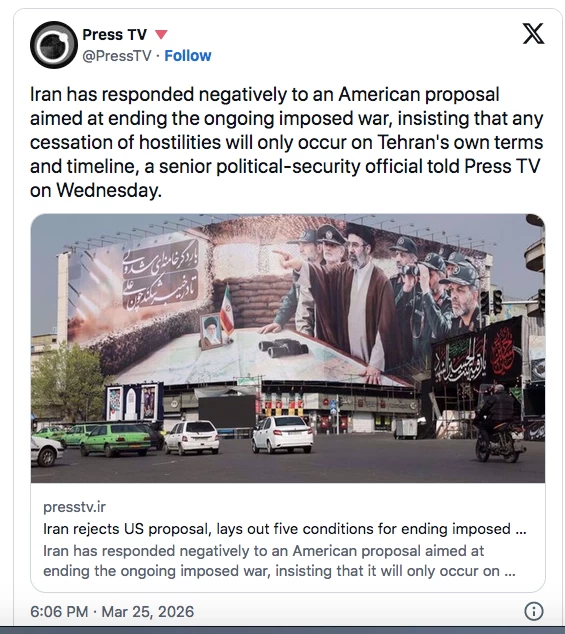
Iranian state television’s English-language broadcaster, Press TV, quoted an anonymous official as saying Iran rejected America’s ceasefire proposal. Press TV’s report came after Pakistan transmitted the proposal to Iran.
"Iran will end the war when it decides to do so and when its own conditions are met,” Press TV quoted the official as saying. The official added Tehran will continue its "heavy blows” across the Mideast.
Press TV, like all of state TV channels, offered its own five-point plan from the official who rejected the US proposal.
It included a halt to killings of its officials, means to make sure no other war is waged against it, reparations for the war, the end of hostilities and Iran’s "exercise of sovereignty over the Strait of Hormuz.”
Those measures, particularly reparations and its continued chokehold over the Strait of Hormuz, likely will be unacceptable to the White House as energy supplies worldwide remain affected by the war.
Iranian state television’s English-language broadcaster quoted an anonymous official Wednesday as saying Iran rejected America’s 15-point ceasefire proposal. Press TV’s report came after Pakistan transmitted the proposal to Iran.
Hope for a possible end to the war in Iran is taking over again on Wall Street, and stocks are back to jumping as oil prices ease.
Here is the latest:
In a strong statement pm Wednesday, UN Secretary-General Antonio Guterres blasted the various factions of the ongoing Middle East conflict, saying the fighting "has broken past limits even leaders thought imaginable.”
He specifically called on the US and Israel, whose joint strikes last month started the war against Iran, to end the fighting as "human suffering deepens, civilian casualties mount, and the global economic impact is increasingly devastating.”
Guterres added, "My message to Iran is to stop attacking their neighbours.”
He also announced the appointment of a personal envoy to the lead the world body’s efforts on the conflict and the recent peace efforts that are underway.
US House Speaker Mike Johnson said pm Wednesday that the war in Iran is "wrapping up” and "the objectives have been met,” even as he described US troop buildup in the Middle East as a warning to Iran.
"The buildup of troops is very different than boots on the ground,” said Johnson. "We don’t have boots on the ground. I don’t think that’s the intention, but I think Iran should watch that build up and they need to take note of that.”
Egyptian Foreign Minister Badr Abdelatty reacted to Iran’s rejection to the ceasefire, saying Egypt will continue it’s efforts to help bring views from the warring parties closer to reaching a compromise and working out their differences.
Egypt supports President Trump’s peace initiative to open the door with the Iranian side for negotiations and is actively working on achieving a ceasefire in Iran, with Abdelatty saying "there’s no winning party in this dangerous escalation.”
Abdelatty said Egypt is in touch with the Iranians through one channel, which is through the Iranian foreign minister Abbas Araghchi.
"History taught us that military solutions is not the answer,” he said during a news briefing in Cairo on Wednesday. "We believe with good intention and political will and with seriousness from both sides, they can exchange views and reach compromise.”