Iran operations are likely to last 4 to 5 weeks but could go longer: Trump
Last updated: March 2, 2026 | 21:35
President Donald Trump awards the Medal of Honour to retired US Army Command Sergeant Major Terry Richardson during a ceremony at the White House on Monday. Reuters
President Donald Trump posthumously presents the Medal Honor to Robert and Linda Ollis, parents of Staff Sergeant Michael Ollis, during a ceremony in the East Room of the White House, Monday, March 2, 2026, in Washington. (AP Photo/Alex Brandon)
Donald Trump shakes hands with Polish Army Captain Karol Cierpica, who was saved by Army Staff Sgt. Michael Ollis in Afghanistan, during a Medal of Honour ceremony in White House. AFP
Donald Trump gestures as he listens to the sounds of a construction site, during a Medal of Honour ceremony at the White House. Reuters
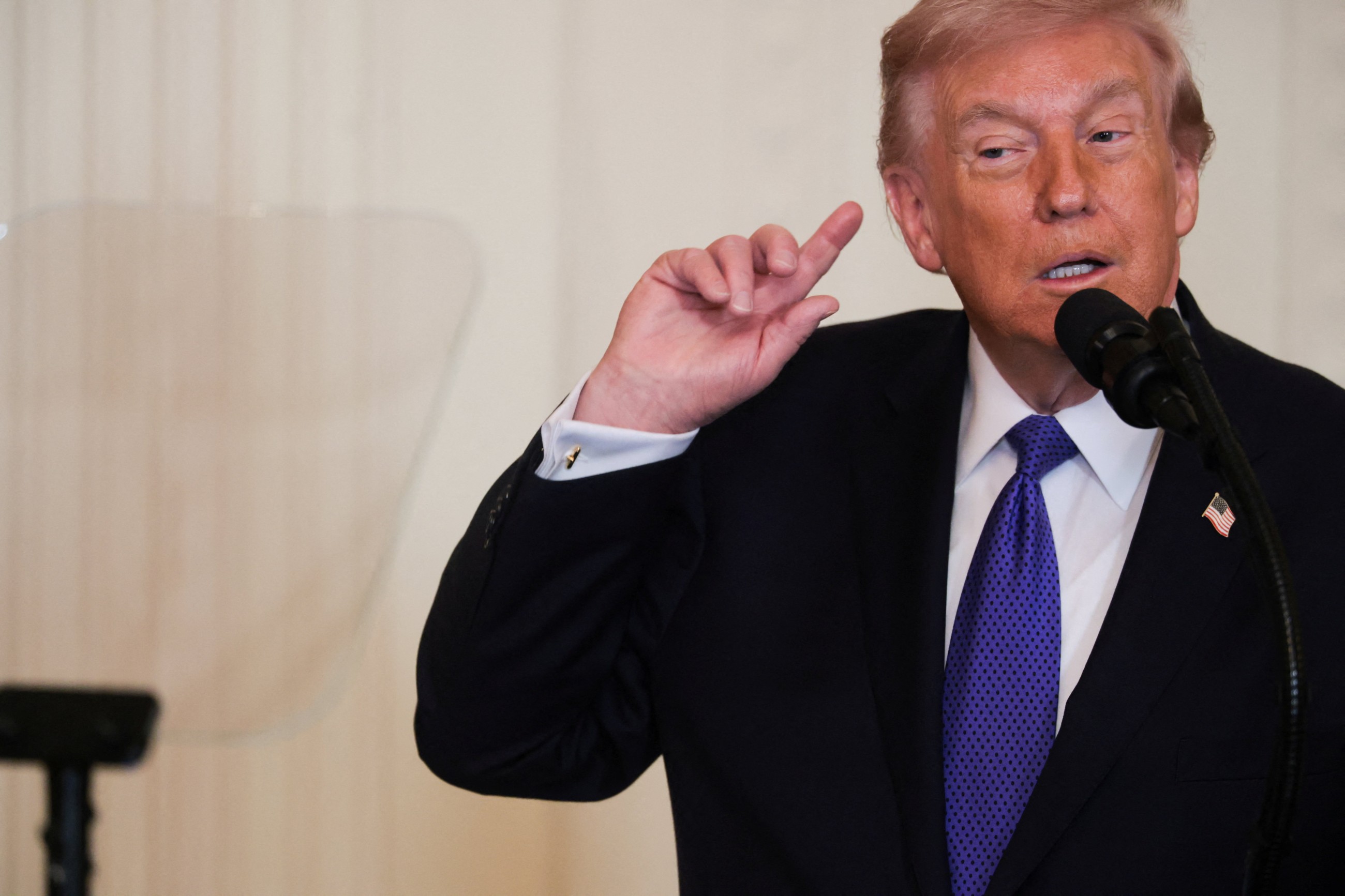
US President Donald Trump says Iran operations are likely to last 4 to 5 weeks but that he’s prepared "to go far longer than that.” Trump spoke Monday at a White House ceremony.
Trump said he is not ruling out sending US troops into Iran, while threatening a new, "big wave" of attacks.
The 79-year-old Republican has long campaigned against decades of US military entanglements in the Middle East, but ordered a large-scale war against Iran starting on Saturday.
While so far the assault has focused entirely on aerial attacks by missiles and bombs, Trump refused to rule out sending ground troops — something far riskier in terms of possible casualties.
"I don't have the yips with respect to boots on the ground," Trump said, using a golf term for anxiety.
"Every president says, 'There will be no boots on the ground.' I don't say it." "I say 'probably don't need them,' (or) 'if they were necessary,'" he told the New York Post in one of numerous brief interviews he has given since launching the Iran operation.
Trump also spoke to CNN on Monday, flagging what he said would be an escalation in the assault on Iran.
Donald Trump gestures as he listens to the sounds of a construction site, during a Medal of Honour ceremony at the White House. Reuters
"We haven't even started hitting them hard. The big wave hasn't even happened," he told CNN, without elaborating. "The big one is coming soon."
US and Israeli forces have so far struck hundreds of targets across Iran, including the Islamic republic's missiles, navy and command-and-control sites. Four US military members have been announced killed and three fighter jets have been shot down -- officially in friendly fire.
The war in the Middle East spiraled further on Monday as Israel and the US pounded Iran. Tehran and its allies hit back against Israel, neighboring Gulf states, and targets critical to the world’s production of oil and natural gas.
Israel and the US bombed Iranian missile sites and targeted its navy, claiming to have destroyed its headquarters and multiple warships. As several airstrikes hit Iran’s capital of Tehran, the top security official Ali Larijani vowed on X: "We will not negotiate with the United States.”
The death toll grew on all sides. The Iranian Red Crescent Society said that the US-Israeli operation has killed at least 555 people.
In Israel, where several locations were hit by Iranian missiles, 11 people were killed. The Iranian-backed Hizbollah group also targeted Israel, which responded with strikes on Lebanon, killing more than two dozen people.
Meanwhile, Saudi Arabia’s Ras Tanura oil refinery came under attack from drones, with defences downing the incoming aircraft, a military spokesman told the state-run Saudi Press Agency.
The refinery has a capacity of over half a million barrels of crude oil a day.
A drone also targeted an oil tanker in the Gulf of Oman, killing one mariner, the sultanate said, while debris fell on an oil refinery in Kuwait.
Several ships have been attacked in the Strait of Hormuz.
"The attack on Saudi Arabia’s Ras Tanura refinery marks a significant escalation, with Gulf energy infrastructure now squarely in Iran’s sights,” said Torbjorn Soltvedt, an analyst at the risk intelligence company Verisk Maplecroft. "An extended period of uncertainty lies ahead.”
Iran’s government news outlet said on Monday that Tehran’s Golestan Palace, a UNESCO-listed heritage site, was damaged in US-Israeli strikes on Sunday
Early on Monday, Cyprus said a drone "caused limited damage” when it hit a British air base there.
Tehran’s streets have been largely deserted with people sheltering during airstrikes. The paramilitary Basij force, which has played a central role in crushing recent nationwide protests, set up checkpoints across the city, according to witnesses.
In the northern Iranian city of Babol, a student, speaking anonymously over concerns of retribution, told the AP that armed riot police were on the streets Saturday night and into the early hours of Sunday after the death of Khamenei.
"We don’t know whether to be happy about the elimination of the criminals who oppress us or to remain silent in the face of the U.S. and Israel’s war against the country and its interests and the terror that is taking place,” he said.