Vineet Nayar captivates audience at 45th Sharjah International Book Fair
- Last updated: November 16, 2026 | 09:15


Raghib Hassan, Staff Reporter
Brilliant minds from across the world descended on the Sharjah International Book Fair (SIBF), leaving visitors spoilt for choice. Since opening its doors on Nov.4, the fair welcomed several acclaimed authors, including Daisy Rockwell, Cynthia Samuel, Clare Mackintosh and Nnedi Okorafor, among many others. But Saturday morning brought a rather different guest from India. A glance at his biography is enough to leave one in awe of his achievements.
He once led one of India’s most successful IT companies, HCL Technologies, steering the organisation towards a new trajectory as its CEO. He is also the author of acclaimed books. His humility is disarming. His gentle manner and engaging conversation make you forget that you are sitting next to a former CEO of one of India’s leading IT companies.
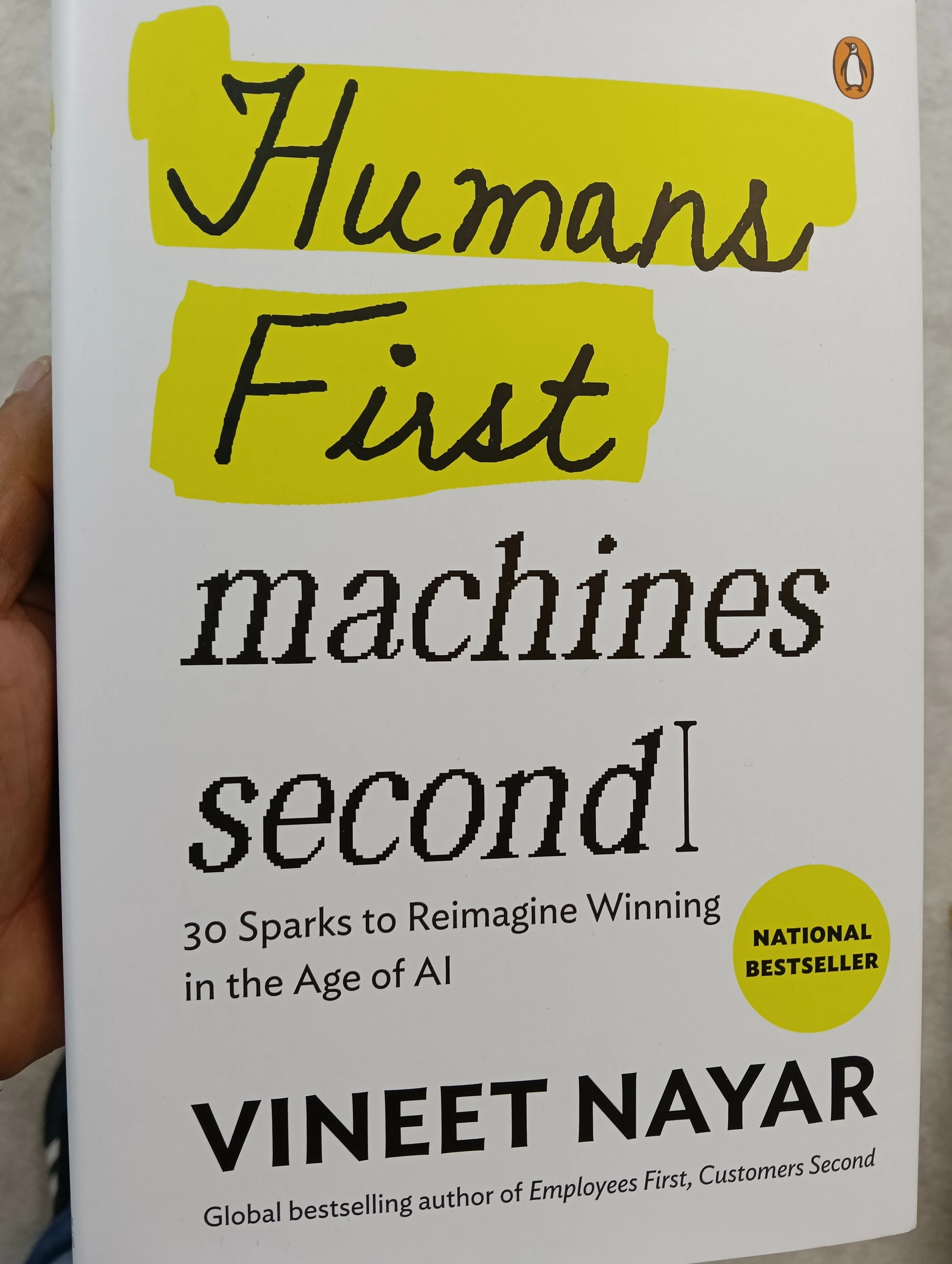
Vineet is the author of “Employees First, Customers Second” and “Humans First, Machines Second.” The former corporate leader is no stranger to the UAE. Recalling his earlier visits, he said, “I would come very often to Sharjah and other Emirates while I was in the corporate world on my business trips.”
“But this is my first visit to Sharjah as an author, and I am feeling extremely happy to be here once again. I have always liked Sharjah. People here are very hospitable.” Having returned after 13 years, Vineet said he was delighted to witness the city’s transformation. New architectural landmarks have replaced many of the older structures, he observed, recalling his previous visits.
He spellbound the Sharjah audience on Saturday morning with an engaging one-hour session at Forum 1 of the SIBF. His talk was so captivating that the audience was left craving more. The moment he concluded his session, readers rushed to get their hands on his books. Vineet graciously obliged almost everyone, signing copies and posing for selfies with his enthusiastic admirers.
His book, “Humans first, Machines Seconds,” is divided into 30 chapters, each offering an interesting perspective and thought-provoking insights. Sharing his insights on the ubiquitous nature of AI, Vineet highlighted how technology has historically created new opportunities rather than simply eliminating jobs or reducing economic activity.
He said, “We have not seen any technology where the number of jobs has gone down or economic activity has declined. Don’t forget that humans have always used technology for their own benefit,” he remarked.
“I truly believe that AI is a fantastic technology. However, it is not a technology that will ever replace human beings. That is the first part. The second, and equally important, is understanding that while AI offers powerful capabilities and an intuitive interface, simply adopting it does not make an organisation different.”
“Can you say that Google Search is a differentiator for your company just because you have implemented it? No, because everybody has Google Search. In the same way, everybody will have AI. What truly matters is how you use AI to create differentiation. That will determine the difference between success and failure,” he added.
Illustrating his point with an interesting example, Vineet drew a comparison between the vacuum cleaner and the refrigerator.
“Look, when vacuum cleaners came in, they made cleaning our homes easier, but they did not fundamentally change our habits. However, when refrigerators came in, everything changed. We started storing food, changed our cooking habits and began cooking once a day or even once a week. Refrigeration transformed the way we lived.”
Both technologies used electricity, but it was the way people used the technology that made all the difference. And that differentiation can only come from the human mind. The same human ingenuity that created the vacuum cleaner also created the refrigerator. The difference lay in how the technology transformed people’s lives,” he explained.
He further pointed out that the person who created the refrigerator went on to generate billions of dollars in value, while the vacuum cleaner did not create the same level of economic opportunity.
“My point is that AI is indeed a fascinating technology. But unless you inspire people to use it to create something extraordinary, you risk missing the biggest opportunity it offers,” he concluded.
Vineet is no stranger to Sharjah. He has been a regular visitor to the emirate, though his role and purpose have evolved over the years. Earlier, he would arrive as a corporate leader, surrounded by people, business meetings and carefully planned agendas. Today, having taken off his corporate hat, he has embraced a different journey — one driven by social purpose and human impact.
Sharing his observations about the younger generation, Vineet expressed concern that many young people are feeling overwhelmed by the growing narrative around artificial intelligence.
He said, “The younger generation is really feeling lost because the vocabulary coming from the West is so strong that they are getting overwhelmed. Very few people like me are telling them not to believe everything they hear.”
“First, they said AI is more intelligent. Then they said AI has a higher IQ. Next, they said AI would take away your job. Now they are saying AI will kill you. Don’t believe all of that. Humanity has always succeeded because of people.”
When asked about the books he enjoys reading, Vineet revealed his preference for books that challenge conventional thinking and offer alternative perspectives.
“I loved Malcolm Gladwell’s ‘The Tipping Point’ and ‘Blink,’ Linda A. Hill’s ‘Genius at Scale,’ and Nassim Nicholas Taleb’s ‘The Black Swan.’ I like books that come up with alternative ideas. That is what I try to do through my own writing as well. It is not the book that is important; it is the idea that matters,” he said.
As the Founder-Chairman of Sampark Foundation, Nayar is now working to improve learning outcomes for millions of children in rural India through technology-enabled education.