What it will take for the Griffith Park merry-go-round to finally spin again
- Last updated: October 25, 2026 | 09:37


Nestled a short stroll from the Griffith Park Ranger Station, near some tennis courts and not far from the remains of the park’s original zoo lies a gem that is on most days behind lock and key. The Griffith Park merry-go-round, which turned 100 this year, stands motionless, many of its 66 wooden horses weathered and caught mid-ascent.
But the effort to ensure that they once again rise, fall and spin around a spherical base has begun. The Griffith Park merry-go-round is being resurrected by a group of passionate supporters and volunteers, some of whom are veterans of the theme park industry. Collectively, they argue that this isn’t simply a relic from another era, but a place of multigenerational connection, a reminder of the beauty of handmade art and a statement piece of Los Angeles.
Shuttered since the COVID-19 pandemic, save for a brief but limited run in 2022, the Griffith Park carousel is now under city control, purchased last year for $1 million. That’s a veritable bargain for such a museum piece, argues Tracy James, who is leading the efforts to restore the project, one that’s expected to take at least two years and cost millions.
“This is the jewel in the middle of the city,” says James, who works in the Department of Recreation and Parks and focuses on Griffith Park. “The ornamentation and the craftsmanship represent a bygone era.”
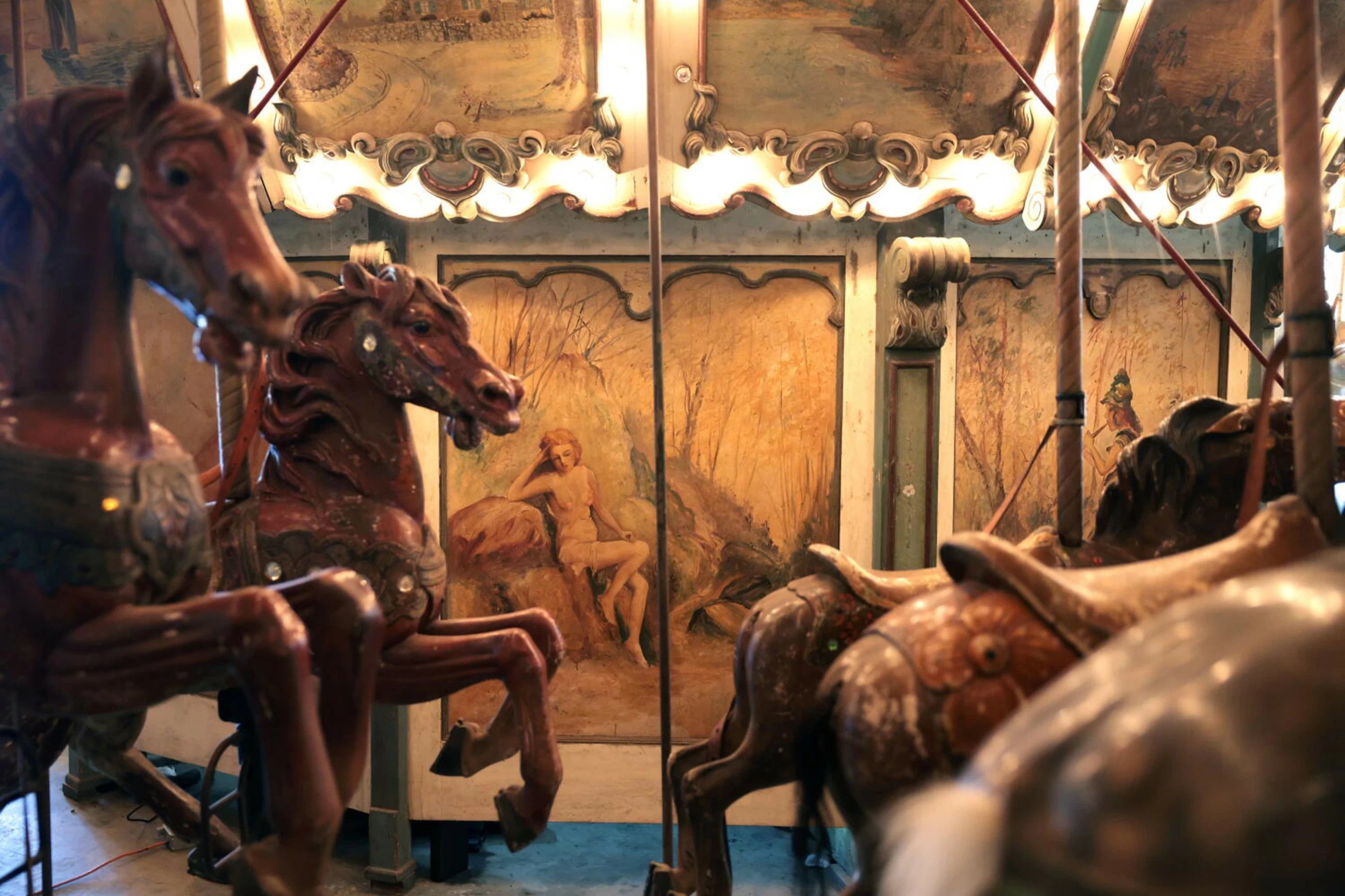
There was a real fear, James says, that the merry-go-round would fall into the hands of a private collector, as the carousel, if not officially, has long symbolically belonged to LA. A piece of whimsy, artistry and play in the middle of a natural wonderland, it is where Walt Disney is said to have dreamed up the vision for what would become the Disneyland Resort and a site that has withstood Civil Rights actions and ‘60s-era love-ins. To some, it’s a beacon of hope in the midst of an imperfect urban fabric that has long prioritised the fantastical.
“I got teary-eyed when I walked up,” says Wendy Osmundson, who approached the carousel during a recent open house while on a stroll around the park. Osmundson reflected on a day, decades ago, when the merry-go-round saved the family’s Christmas.
“I was 21, and my mom’s kitchen burned down,” Osmundson says. “We couldn’t have Christmas at my mom’s house. Everyone came to my one-bedroom apartment in Los Feliz, and me and my three sisters came here and rode the carousel. We were adults, but it was really great. I’d love to see it restored.”
Joining the project to do just that are some of the brightest minds in the theme park and amusement industry, and they’re doing so without pay and on their own time. Kurt Sawitskas has already spent weeks analysing the carousel’s innards, marveling at its antique nature, but also being amazed that it’s still mostly intact.
“Honestly, I don’t think carousels were ever intended to last 100 years,” Sawitskas says. “And now here we are with a carousel that’s 100 years old. We want to honor it and make it run again.” Sawitskas’ day job is at Walt Disney Imagineering, the creative arm of the company responsible for theme park design. Beginning to think ahead toward retirement, Sawitskas says he was looking for a project in which he could volunteer his time and expertise. He found it.
Built in 1926, near the end of what many consider the heyday of the American carousel, the Griffith Park merry-go-round began its life in San Diego and was relocated to Los Angeles in the depths of the Great Depression in 1937. It is the showcase product of the Spillman Engineering Co., whose carousel horses were known for the flowing, wind-blown manes and heavily detailed secondary carvings on the portion of their bodies that face viewers, known as the “romance” side.
A few, for instance, have lion heads extending from their chest. Others have cherubs reaching toward the horse’s face. All are adorned with jewels and tails made of real horse hair, many of which have been eaten by squirrels or other critters. Griffith Park’s carousel is especially unique in that it also has horses from master carvers Charles Looff and Charles Carmel, considered the finest carousel craftsmen of the era. The few carousel companies that survived the Depression largely did so by switching to a cheaper, mass-produced product, such as transitioning from wood to aluminum. An art was lost.
“It’s brought to me a real appreciation of the deeper aesthetic,” Sawitskas says. He mentions this as he’s giving a tour of the horses, emphasising how the thickness of the paint created a sense of depth in the figures — a saddle, for instance, of a crisscrossing chessboard-like pattern, or elsewhere an aged leathery toughness. “I recognise what is attractive about an amusement like this, and that’s the ability to return again and again and still see something different.”
Sawitskas has recruited a pair of co-workers, Troy Leverton and Pim Renting, who work in various aspects of ride engineering, to help in the task. For Leverton, restoring the carousel is important in bringing a piece of history back to the city, one centered on affordable outdoor entertainment. “I brought my nieces here 10-plus years ago, and rode it and it was really cool,” Leverton says. “Unfortunately, since my daughter has been born this has been shut down. So it was like, you know what, I live in the city, and it’d be really cool to be a part of something that is doing something for the city. I want to bring my daughter back here when it is running.”
It’s also not lost on them that there’s an association between the company they work for and the carousel, although it’s important to stress they are not volunteering their time as representatives of the Walt Disney Co.
Tribune News Service