Nada Elkalaawy’s show at Lawrie Shabibi discloses surprises of strength and fragility
- Last updated: September 9, 2026 | 09:41


Muhammad Yusuf, Features Writer
Contemporary art gallery Lawrie Shabibi housed in Dubai’s Alserkal Avenue, has announced The Butterfly’s Burden, a solo exhibition by Egyptian artist Nada Elkalaawy (Sept. 23 – till Nov.). Borrowed from the poetry of Mahmoud Darwish, the exhibition’s title speaks of the tension between sensitivity, beauty, and emotional weight. Across a body of paintings developed through processes of accumulation and erasure, Elkalaawy explores memory, loss and regeneration, set amidst the passage of time. Ephemeral forms including flowers, butterflies, domestic vessels, family photographs, and ghostly figures, hold traces of shared human experience, drifting between past and present, presence and absence.
Elkalaawy’s practice is grounded in the relationship between memory and its representation. Drawing from a personal photographic archive accumulated over many years comprising family albums, still lifes, auction catalogues and found imagery, she constructs compositions that blur the boundaries between the lived, the remembered, and the imagined. Through processes of collage, reworking, and painterly methods, these fragments are displaced from their original contexts and ceaselessly absorbed into new configurations. The resulting paintings do not function as direct representations of specific memories or narratives, but as spaces in which personal and collective histories, and multiple temporalities, coexist.
Drawing plays a fundamental role in the artist’s process. Almost every work begins with a sketch, with charcoal and graphite serving as preparatory and exploratory mediums, before the image develops through painting, with charcoal allowing for rapid shifts in tone and gesture. Painting ultimately becomes a space for mystery and transformation, allowing the artist to deconstruct and reconstruct fragments of time, as the artist searches for new relationships between images. Veiling and pentimento are central to her art process.
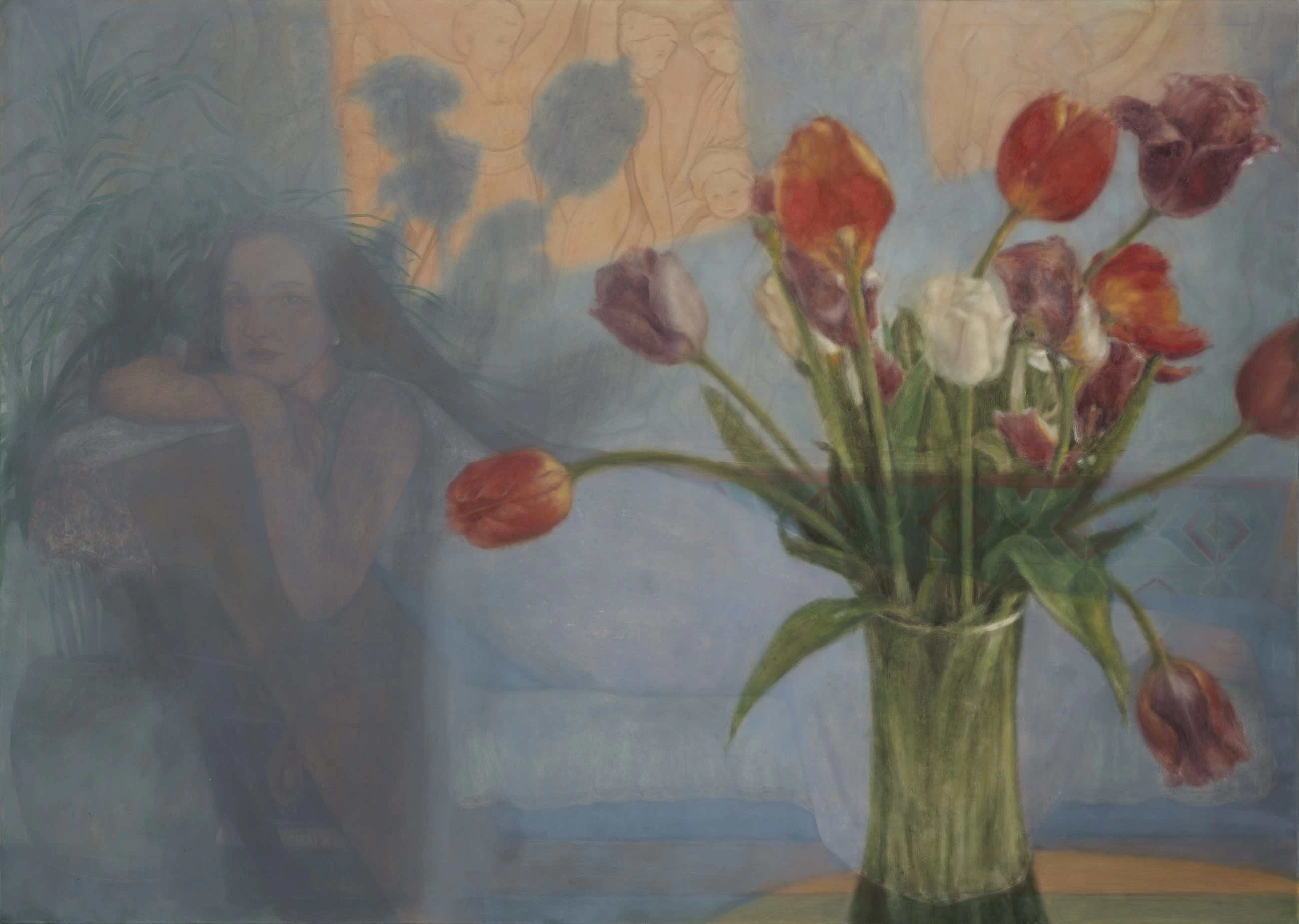
Layers of translucent paint obscure and disrupt forms, creating shifting depths in which images emerge, recede, and dissolve across the picture plane. The withholding of information slows the act of looking, establishing tension between visibility and concealment. Earlier painted gestures and imagery remain embedded beneath the surface, particularly through the reworking of older canvases and unfinished works. The palimpsest functions as metaphor for memory itself: unstable and fragmentary, continually shifting rather than fixed.
This process results in the emergence of ghostly figures that populate the backgrounds of several of her paintings, fluttering at the edge of visibility. Almost imperceptible, they remain nonetheless present, suggesting memories that resist forgetfulness. Alongside these figures, recurring motifs including flowers, domestic objects, and textiles, carry emotional and symbolic weight. Flowers become markers of tenderness, beauty, regeneration and mourning, while silverware, tureens, candelabras, porcelain figurines, urns and fragments of interiors, function as repositories of memory and human presence.
The objects are not presented as static still life elements, but as charged forms that evoke ritual, preservation, longing, and care. The figures that emerge from within these constructed spaces are at times suspended between clarity and dissolution. Shadows, reflections and glares, further complicate an image, disrupting the stability of the depicted forms and introducing ambiguity between what is seen and what is concealed. By disconnecting objects and figures from their original milieus, Elkalaawy creates a space for fabrication and reinterpretation, allowing familiar images to acquire new associations and meanings.
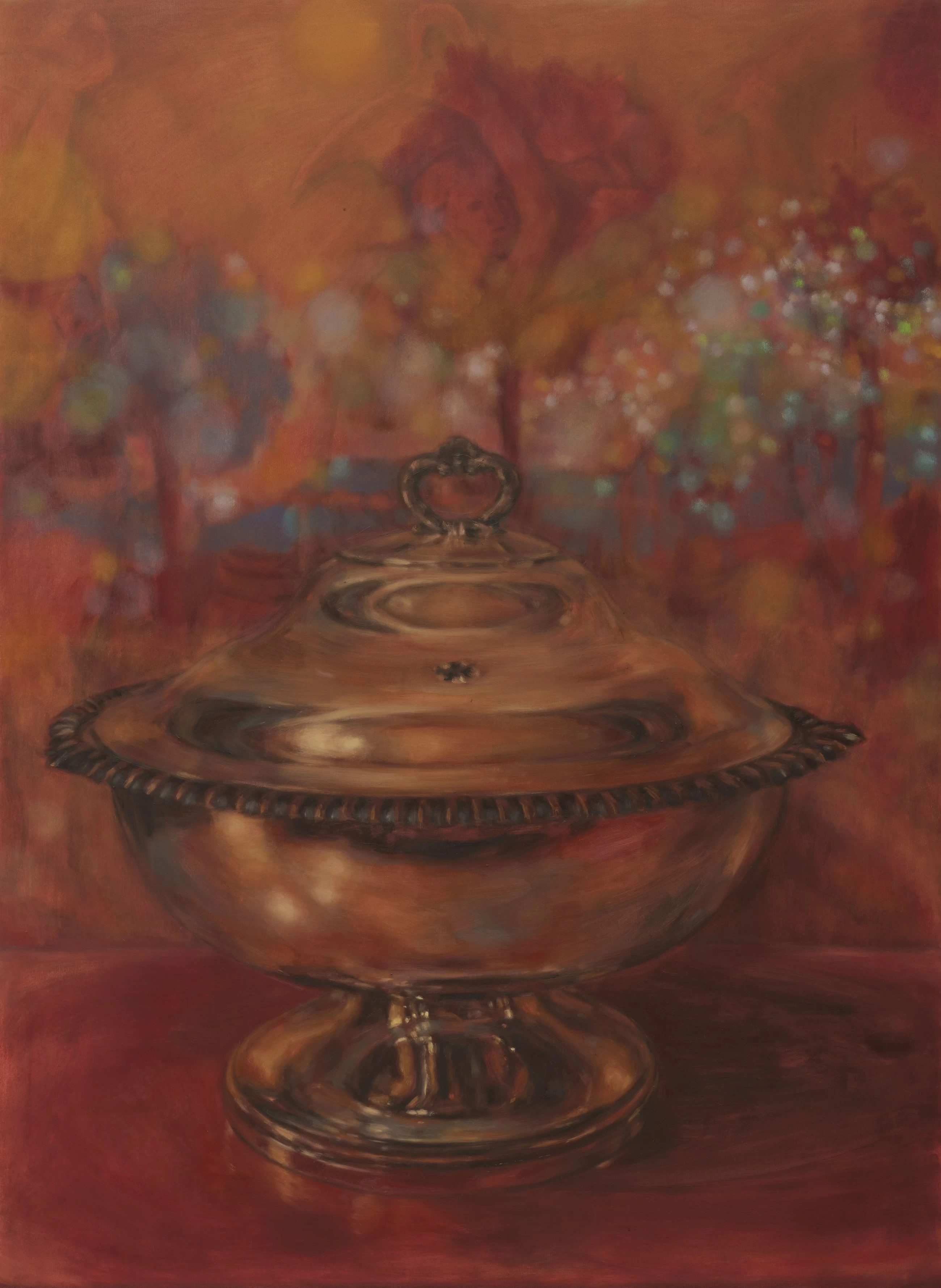
The repetition of imagery across different compositions also investigates the relationship between memory and representation. The same subjects may appear across varied contexts, scales, and configurations, transforming their meaning through new placements. Elkalaawy’s engagement with illusion, whether through the techniques of realism or the manipulation of imagery, challenges the possibility of a definitive reading. Painting becomes a site where histories accumulate, disappear and resurface, and where the distinction between fact and fiction remains unclear.
The works in The Butterfly’s Burden emerged from Elkalaawy’s own experience of recent loss and grief, while also providing hope. They are shaped by a series of dualities: foreground and background, familiarity and surreality, happiness and sadness, hope and despair, life and death, much as personal experiences. The butterfly is associated with freedom, transformation, and the fleetingness of life. It is also presented as carrying a burden - that of grief, longing, remembrance, and the responsibility of carrying forward what must not be lost. Like the butterfly, whose transformation renders it almost unrecognisable from what it once was, Elkalaawy’s paintings find renewal through processes of remaking. Earlier images are concealed, altered and absorbed into new compositions, continuing to persist beneath the surface.
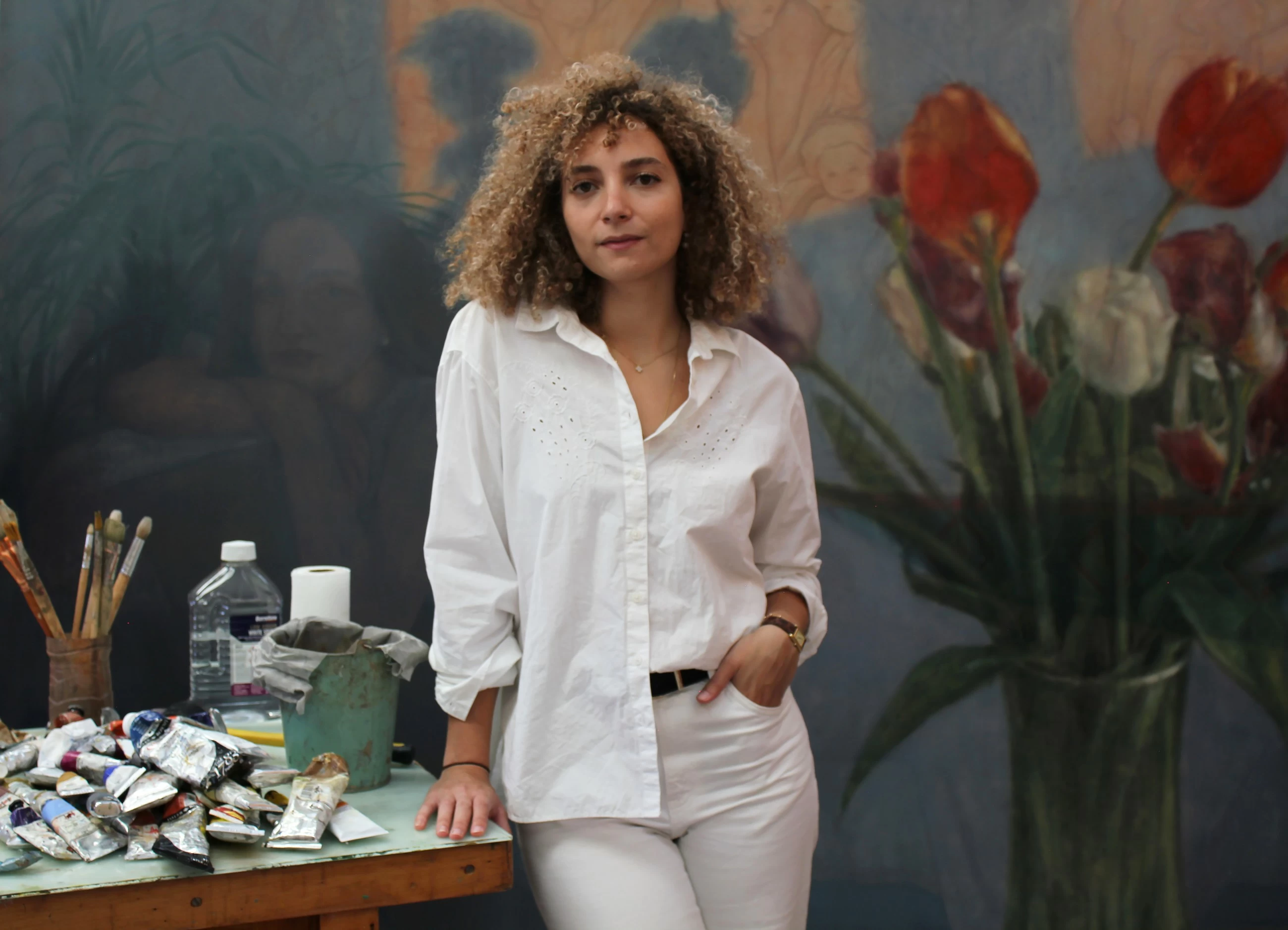
Through continual movement between preservation and loss, Elkalaawy’s paintings create spaces where absence and presence, fragility and strength, and past and present remain in dialogue. While rooted in personal sources, the works seek to evoke experiences that extend beyond the individual, including togetherness and loneliness, love and grief, vulnerability and resilience, and the search for one’s place within the world. The Butterfly’s Burden proposes painting as a space where memory can be materialised, carried, renewed and create human connections.
Lawrie Shabibi supports the long-term development of the careers of young international contemporary artists, with a focus on those from the Middle East and North Africa. The gallery organises art historical exhibitions working with an older generation of artists from the region. Liaising with curators, institutions, museums and collectors, LS has successfully introduced international artists to the region, while at the same time presenting Middle Eastern artists to the international contemporary art community. By holding a regular programme of exhibitions, screenings and talks, publishing catalogues and participating in international art fairs, the gallery has been a forerunner in the development of the contemporary art scene in Dubai.