David Hockney, iconic artist known for his colourful landscapes, dies at 88
- Last updated: June 13, 2026 | 08:57


Artist David Hockney, whose paintings of pools shimmering in the Los Angeles sunshine became icons of 20th-century art, died Thursday, his publicist said. He was 88. Hockney was born in the north of England but lived much of his life in Southern California, making its sun-drenched suburban views a major motif. Later in life he returned to Europe, finding renewed inspiration in the wooded hills of his native county of Yorkshire and the fields and trees of France’s Normandy region.
He became one of the UK’s most treasured artists, his works selling for record prices at auction. With his trademark round glasses and bleached-blond hair, Hockney was a well-known figure in the swinging British and American art scenes of the 1960s, even before he reached the age of 30. His paintings were just as distinctive, many of them creating a dreamlike world of patterned light bouncing off water and windows, and human forms rendered in flattened, simplified shapes in matte acrylic paint.
Hockney was born on July 9, 1937, in Bradford, a large industrial city whose chief export was woolen textiles. He spent his first two decades there before going to London’s Royal College of Art. He made an impact even before his graduation, and art dealer John Kasmin took him into his stable of artists in 1961. His artistic influences ranged widely, from Renaissance portraitists to 19th-century English landscape painter J.M.W. Turner, Pablo Picasso’s experiments in Cubism and 20th-century American pop art.
Visiting the United States in 1963-64, Hockney gained notice with his update on “A Rake’s Progress,” 18th-century artist William Hogarth’s series of paintings telling the story of a wealthy cad’s escapades and eventual downfall. The New York Times said in 1964 that Hockney “brings Hogarth up-to-date with a vengeance and furnishes a good example of how younger artists like to marry text and picture with benefit to each.”
He shared with other pop artists an interest in the polished surface of modern life. And, like Andy Warhol with his Brillo boxes and Campbell’s soup cans, Hockney occasionally incorporated advertising labels, such as a British Typhoo Tea box used in his 1961 “Tea Painting in an Illusionistic Style.” He told “The New York Times” in 1964 he enjoyed the burgeoning pop art scene in New York but wasn’t sure he was part of it.
Even his move to California had a historic precedent, he noted, since earlier generations of English artists had sought out the brilliant light of Italy. Early in his career, two of his drawings were bought for the Museum of Modern Art in New York.
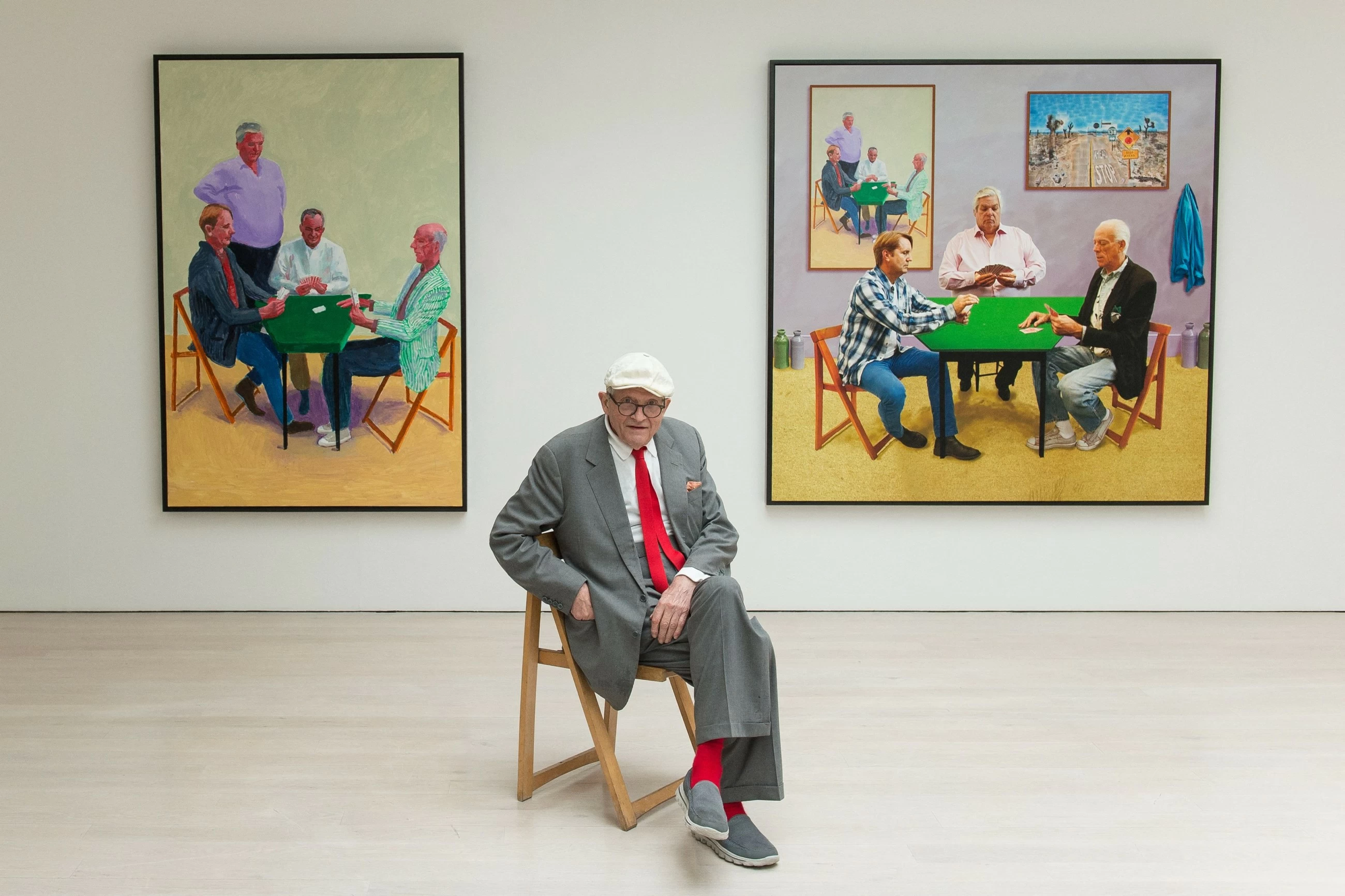
“The moment I first sold pictures to earn a living, I felt rich. I’ve been rich ever since,” he told The Associated Press in 1995. “I didn’t have much money but I did what I wanted. ... You are a rich man if you do the things you want to do.” That freedom brought Hockney acclaim and wealth, with his works fetching record-breaking sums. In 2018, his 1972 painting “Portrait of an Artist (Pool with Two Figures)” sold at a Christie’s auction for $90.3 million, at the time a record for a living artist. In February 2020 another pool painting, “The Splash,” from 1966, sold at Sotheby’s for 23.1 million pounds ($30 million).
While many of his best-known paintings had American scenes, he also tackled British subjects. He immortalised his parents in several portraits. “Mr. and Mrs. Clark and Percy,” a 1971 dual portrait of two of his English friends and their cat, was ranked No. 5 in a 2005 BBC Radio-National Gallery (London) online poll of the greatest paintings in Britain. It was the only work by a living painter in the top 10.
He didn’t limit himself to drawing and painting, though. He contributed costume and set designs for theatre and the opera, including a celebrated production of “Tristan und Isolde” first staged in 1987 at the Los Angeles Opera. When he took up photography, he fused genres, assembling individual photos into elaborate collages like “Pearblossom Highway, 11-18th April, 1986,” built up of individual views of a desert highway intersection.
The insight he gained from his photo work led him to research and write a 2001 book, “Secret Knowledge: Rediscovering the Lost Techniques of the Old Masters.” He argued that through the centuries, artists used lenses and other optical devices to aid them in drawing much more often than most historians believe.
Later he began to draw on iPads, which became his favorite tool. In the early 2000s he looked afresh at the fields and forests of Yorkshire in a series of exuberant landscape paintings that combined bold colour with minute attention to the texture of snow on a hillside or a blossom on a hawthorn hedge. Hockney used the English landscape for inspiration in his design for a stained-glass window at Westminster Abbey to celebrate the long reign of Queen Elizabeth II. Completed in 2018, the Queen’s Window depicts a landscape of blossoming hawthorn trees in hues of blue, green, yellow, orange, pink and red.
Associated Press