Shalabiya Ibrahim brings Levantine and Nilotic sensibilities to Artbooth Gallery
- Last updated: June 9, 2026 | 09:14


Muhammad Yusuf, Features Writer
Abu Dhabi’s Artbooth Gallery is currently presenting Fields of Memory, a solo exhibition by Shalabiya Ibrahim, pioneering Egyptian born artist (May 14 - June 21). Curated by Randa Sadaka, Fields of Memory offers a rare and intimate journey into a visual language shaped by the intersections of Egyptian and Syrian modernities. The show unfolds as a vibrant tapestry of lived experience and imagination. Ibrahim’s (b. 1944) work exists at a unique cultural crossroads: born in Monufia, Egypt, in 1944, and long based in Syria, her practice is thoroughly informed by the visual traditions of the Levant and the rural soul of the Nile.
The exhibition inter alia highlights Ibrahim’s mastery of colour as a language. Her dense, saturated palettes more than fill space; they carry an immediate affective presence, acting as cultural anchors. Her aesthetic, rooted in folk and popular art, utilises stylised figures and simplified forms, to create compositions that are at once universally accessible and totally symbolic. “Shalabiya’s work allows the ordinary to exist within a shared visual memory,” says curator Randa Sadaka. “Everyday gestures and familiar faces are elevated, becoming archetypes of continuity and renewal.” The female figure is central to Ibrahim’s world, embodying earth, fertility, and enduring connection to the land. Drawing from her rural Egyptian upbringing, the artist also populates her poetic compositions with animals and symbols derived from village life and Nile folklore.
Ibrahim’s apparently “spontaneous” style is a testament to her self-taught origins and her ability to capture the essence of a narrative through minimal, yet expressive, lines. She is a self-taught painter known for her instinctive and lyrical depictions. Encouraged by Syrian painter Nazir Nabaa, she developed a practice centered on symbolic female figures representing fertility, motherhood, and renewal. Most of her early production focused on woman as the main theme because she believed that woman is the centre of the universe.
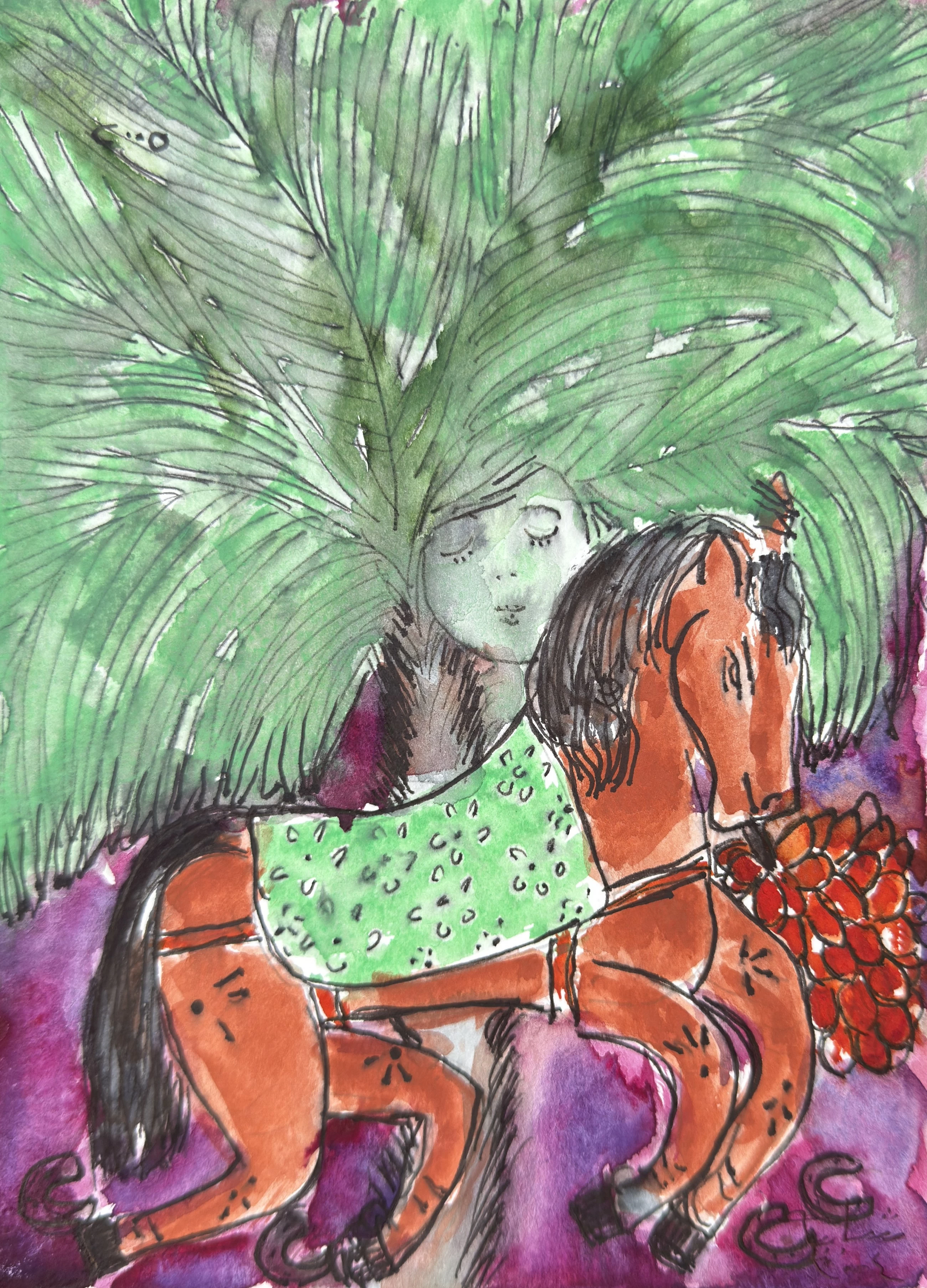
Birds fly around her and even horses and fish do so. There are no barriers between the sky, the earth and the sea, and everything depicted in a painting surrounding the woman is influenced by her flexibility, elasticity, freedom and movement. Perhaps the dreams of the artist or the memories of her childhood were the source of her inspiration. Working primarily in watercolour, pastels and mixed media, Ibrahim has exhibited internationally across the Middle East and Europe, since the 1970s. She has participated in solo and group exhibitions in Egypt, Germany, Syria, Lebanon, Spain, Tunisia, France, the UK, Kuwait and Jordan. Her artworks are held in important regional and private collections, including the Dubai Collection, the Museum of Fine Arts in Damascus, the Jordan National Gallery of Fine Arts in Amman, as well as notable private holdings such as the Chakkour Collection and the Atassi Foundation.
Known in artistic circles as a free flowing and spontaneous painter, Ibrahim says that “what I am doing is simple and uninformed ... (my) imagination develops the vision which has matured over the years ... I still see it as a magical world full of details and scenes that is never exhausted.” She began drawing even as a teenager. Later, when she married Syrian artist Nazir Nabaa, he encouraged her to go further with the creation and exhibition of her work. With minimal lines and colour spaces, and influenced by her rural childhood and legends of the Nile river, her work deals with women as representative of the idea of the earth, the mother, reproduction and renewal. These figures are foregrounded and portrayed in tender and free-spirited ways, while the backgrounds have narrative elements or have objects with symbolic meanings.
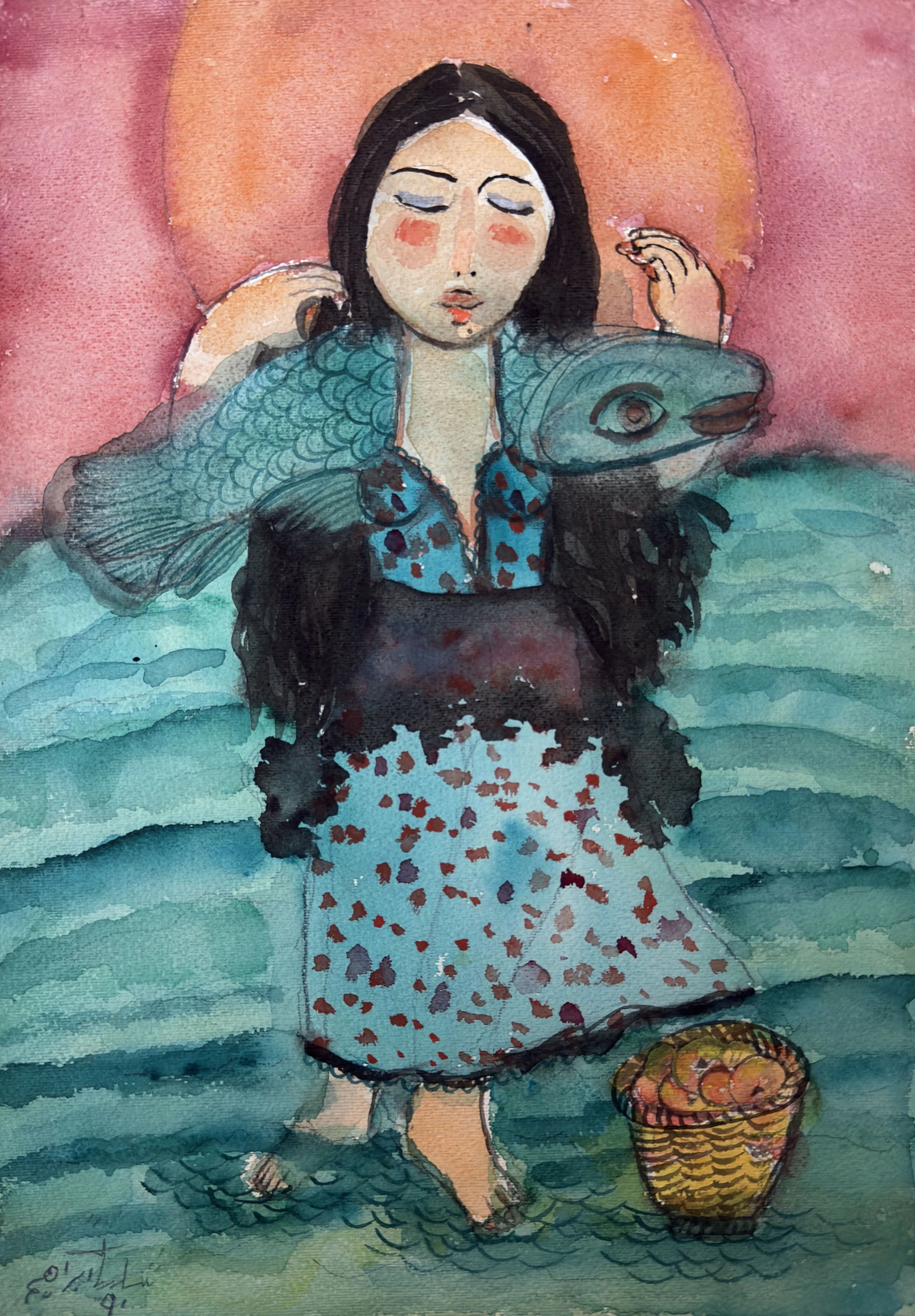
Her expressive figuration and poetic depictions of women have been developed in a distinctive style rooted in emotion, storytelling and the lived experiences of Middle Eastern women. Her work stands as a powerful example of independent artistic expression outside academic frameworks. Ibrahim also employs open colour fields to create poetic compositions populated by symbolic female figures, animals, and elements drawn from myth and village life along the Nile. Through a practice defined by instinctive mark making and narrative imagination, she has established a distinctive voice within modern Arab art. Her works continue to resonate through their expressive simplicity, celebrating memory, femininity, and the enduring mythology of everyday life.
An AI Overview underlines that “for over five millennia, the Nile has served as the pulsing heartbeat of Egyptian identity. It is not just a geographical lifeline, but a profound muse, shaping the country’s visual arts, generation after generation.” Travelodeal.co.uk notes that “the Nile River has profoundly influenced Egyptian art and architecture, consequently impacting its culture. The Great Waterway has been an inspiration source for all Egyptian artists since ancient times. Egyptian art and architecture along the Nile have been characterised by riverine themes and agricultural motifs. These artworks represent how vital this river was in sustaining life and symbolise fertility accompanied by abundance.”
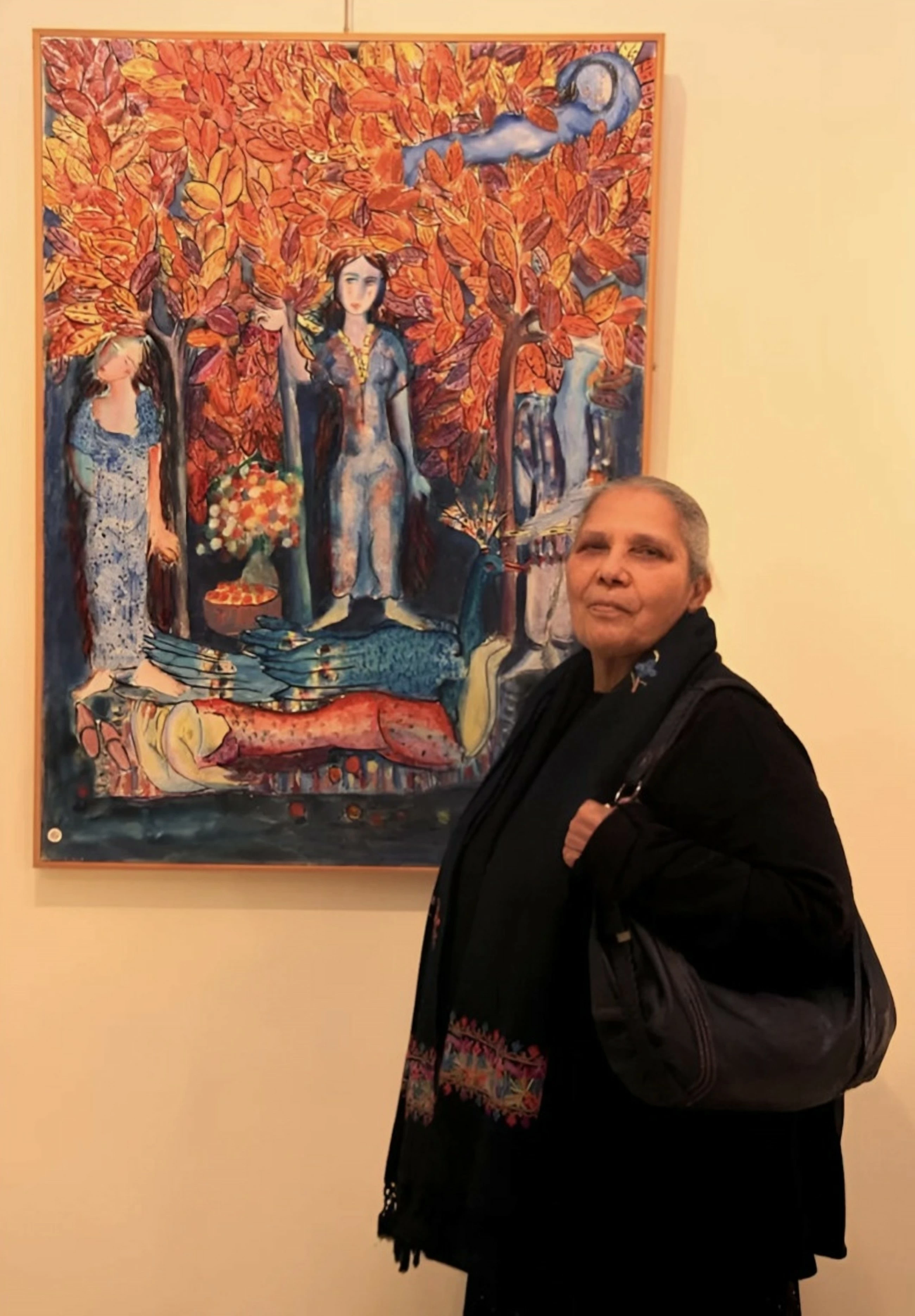
“Far more than a geographical reality,” says english.ahram.org, “the Nile is the narrative thread of identity and the ultimate source of inspiration for its creators. From the pioneers of symbolism to contemporary voices, this ancient river becomes a mirror of the Egyptian soul, as artists chronicle their country’s history generation after generation.” Founded in 2019 by Roger El Khoury, Artbooth Gallery fosters cross-cultural artistic dialogue through a thoughtful exhibition programme. With spaces in Abu Dhabi and Seoul, the gallery supports both emerging and established artists, presenting contemporary art from around the world.