Stories R Us: Khozema Al-Aaed’s legends connect people at Firetti Contemporary
- Last updated: April 14, 2026 | 09:24


Muhammad Yusuf, Features Writer
The Firetti Contemporary presentation We Walk on Stories (Feb. 13 – May-end) curated by Lina Mikati brings together works from Khozema Al-Aaed’s ongoing Cities series, examining how land registers human presence over time and how place is shaped by movement, memory, and lived experience, rather than fixed geography. Al-Aaed is an artist and product designer from Syria whose practice engages with mapping as both a visual system and a cultural construct.
Rather than treating maps as neutral tools of orientation, his works question what is lost when experience is reduced to borders, routes and labels. Through abstract cartographies, he shifts focus from direction to remembrance, allowing memory, absence and emotion, to surface.
Years of working amid fractured urban environments sensitised him to how cities absorb human experience beyond the obvious destruction. Rather than depicting specific events or sites, his work engages with the quieter aftermath of change, where histories live on beneath the surface.
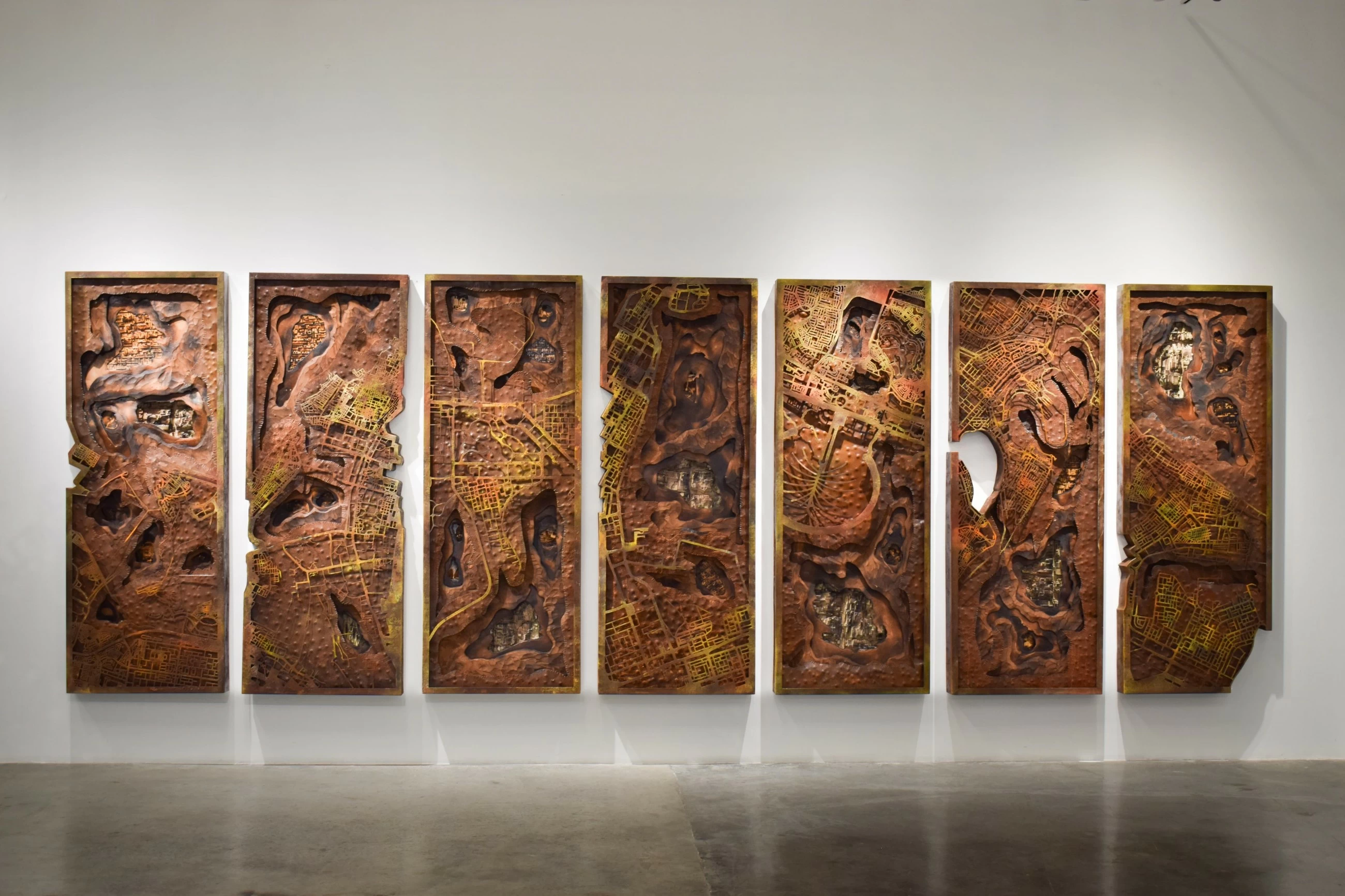
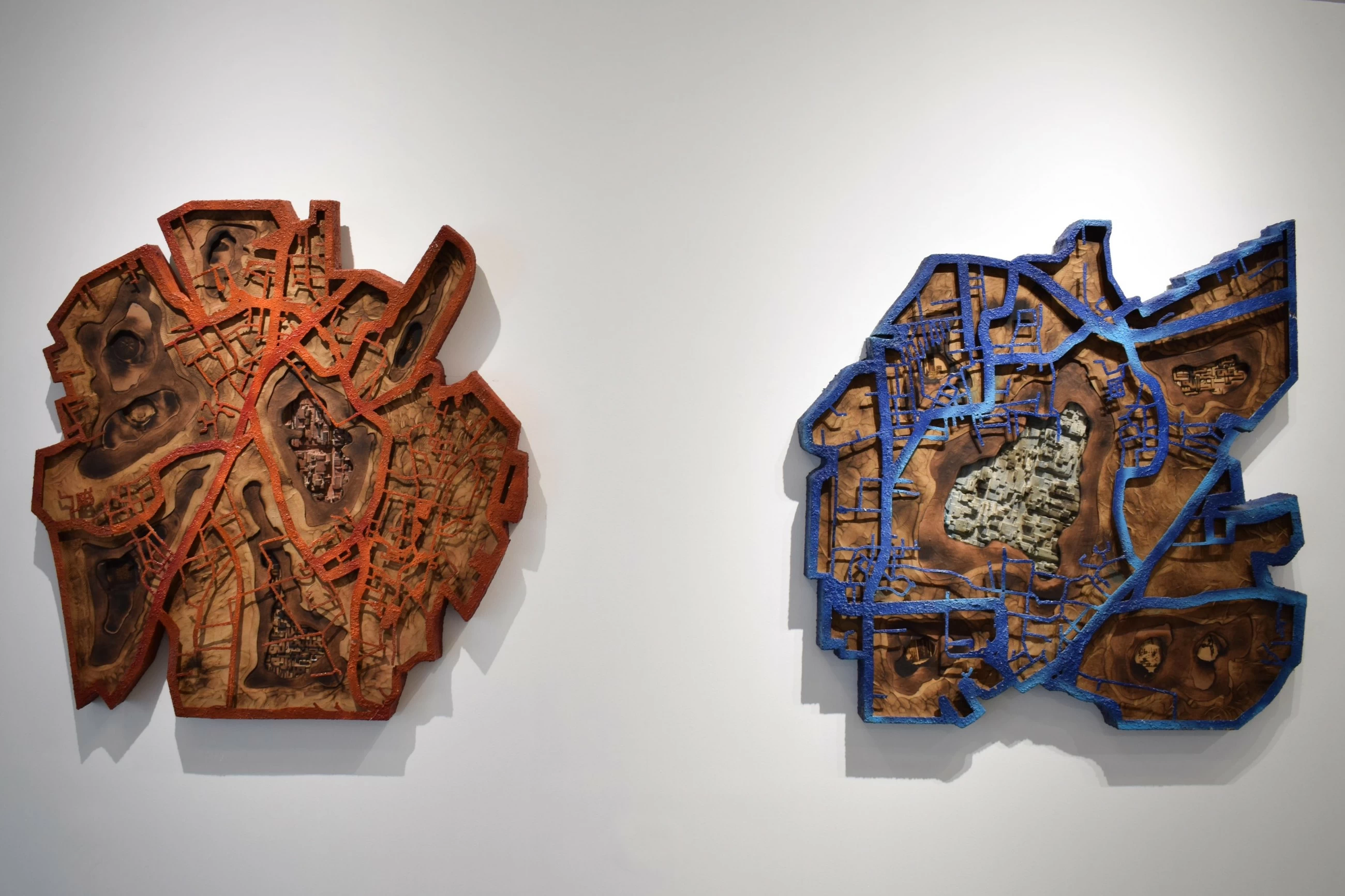
The Cities series is an evolving visual archive. Conventional markers such as names, borders, and fixed routes are removed, allowing lines to suggest interrupted paths and moments of decision on the direction to be taken, while open spaces refer to erasure and absence. They are not maps designed to guide movement, but compositions that register lived experience.
Materiality plays a central role in Al-Aaed’s practice. Constructed from iron, stone, clay, wood and pigment, his works carry both physical and symbolic weight. The surfaces appear fractured yet are resilient, bearing marks of pressure, erosion, and time. The materials reference both urban infrastructure and natural elements, underlining that the landscapes have been lived in. Rooted in experiences familiar to the Arab diaspora, We Walk on Stories reflects a broader condition shaped by migration, mobility and shifting notions of home. The exhibition speaks to lives lived between places, cultures and identities, where belonging is a carried reality rather than a fixed substance.
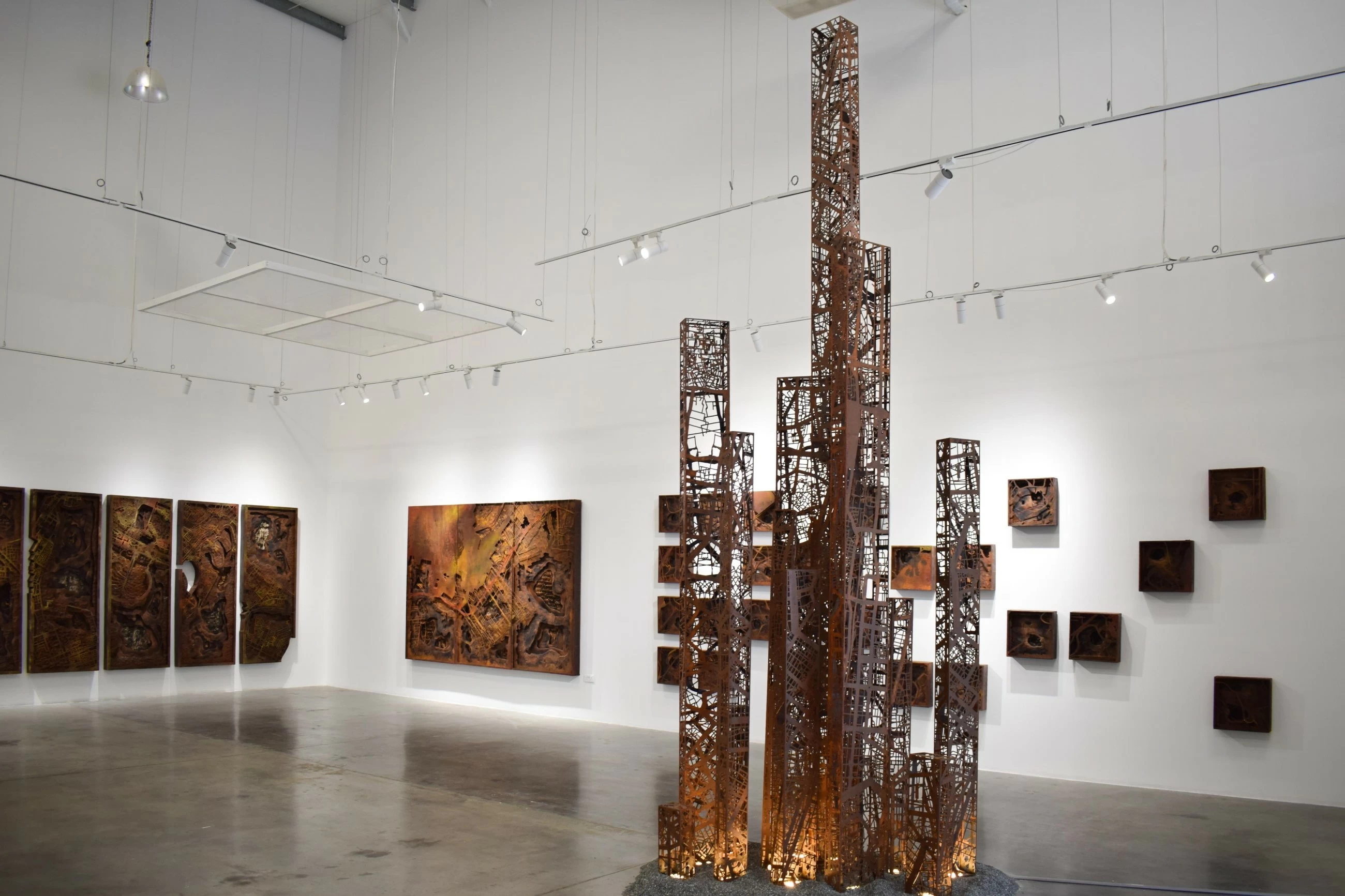
However, the works do not merely describe displacement; they transform maps into emotional terrains shaped by memory, loss, and the quiet persistence of belonging. Through reimagined maps, Al-Aaed transforms the language of customised mapping into a universal vocabulary, one that resonates beyond Syria to address broader questions of migration, belonging, and how land continues to remember the stories of those who walk upon it. Al‑Aaed’s practice engages with the city as a living entity bearing traces of human passage; he re‑reads geography as an emotional and mnemonic space, rather than as a purely architectural form. He invites viewers to reflect on their relationship with the land and their experiences with shared memory and what exists amid continuous transformation.
For curator Lina Mikati, the exhibition is also deeply personal. Coming from the same country and shaped by experiences of war and rupture, her response to Al-Aaed’s Cities series was immediate and instinctive. She is an art collector, art philanthropist and cultural advocate, whose passion for creativity has been shaped by a life lived across continents as the daughter of a diplomat. Over the past three decades, she has built a collection rooted in Middle Eastern art, enriched by works acquired during her travels that reflect her personal sensibility and curiosity. As an art philanthropist, she supports emerging artists by opening welcoming doors for them, placing their works in galleries, and facilitating curatorial opportunities that amplify their voices. Her commitment to nurturing talent reflects her deep belief in art as a bridge between cultures and communities.
She is the founder of Artopia, a cultural social initiative that brings together friends and art enthusiasts for fruitful encounters with art in its various forms. She is also a non-executive co-founder of The Art Circle, where she spent seven years fostering cultural dialogue and appreciation. As a VIP Ambassador for Contemporary Istanbul, she continues to strengthen connections between regional and international art ecosystems. “We Walk on Stories emerges from Khozema Al-Aaed’s long-standing engagement with questions of place, displacement, and memory,” Lina says. “The exhibition enters into conversation with poetry not as a point of departure, but as a parallel voice. Syrian poet and diplomat Nizar Tawfiq Qabbani’s words – “I walk on the map’s paper, afraid, for on the map we are all strangers” - resonate here as recognition of this condition.
“The abstract cartographies from the ongoing Cities series move beyond geography to explore land as a witness, a surface that absorbs movement, history, and feeling. Stripped of names, borders and defined routes, these works reveal what emerges when orientation is no longer physical, but deeply personal.” Lina points out that Al-Aaed developed his practice within a landscape shaped by conflict, displacement and continual transformation.
Working for years in a war-torn environment, the artist witnessed how cities fracture, rebuild, and retain the emotional weight of those who inhabit them. But rather than depicting destruction directly, Al-Aaed engages with its quieter aftermath, as in memory embedded in streets, absence etched into pathways, and histories that linger beneath the surface.
The materials used such as iron, stone, clay, wood, and pigment, embody landscapes shaped by both tenderness and erosion, permanence and fragility, she notes. “In an increasingly mobile world, Al-Aaed speaks to lives shaped by movement between places, cultures, and identities, where home is no longer singular, but carried through memory and experience. “Al-Aaed affirms that we are all walking stories, shaped by the lands we traverse, and connected by the stories we carry with us.” And thus we are not strangers.