Greek artist gains global acclaim for Kalamata mural featuring Maria Callas
- Last updated: February 19, 2026 | 09:27


Long known for its olives and seaside charm, the southern Greek city of Kalamata has found itself in the spotlight thanks to a towering mural that reimagines legendary soprano Maria Callas as an allegory for the city itself. The massive artwork on the side of a prominent building in the city centre has been named 2025’s “Best Mural of the World” by Street Art Cities, a global platform celebrating street art. Residents of Kalamata, approximately 240 kilometres (150 miles) southwest of Athens, cultivate the world-renowned olives, figs and grapes that feature prominently on the mural. That was precisely the point.
Vassilis Papaefstathiou, deputy mayor of strategic planning and climate neutrality, explained Kalamata is one of the few Greek cities with the ambitious goal of becoming climate-neutral by 2030. He and other city leaders wanted a way to make abstract concepts, including sustainable development, agri-food initiatives, and local economic growth, more tangible for the city’s nearly 73,000 residents.
That’s how the idea of a massive mural in a public space was born. “We wanted it to reflect a very clear and distinct message of what sustainable development means for a regional city such as Kalamata,” Papaefstathiou said. “We wanted to create an image that combines the humble products of the land, such as olives and olive oil — which, let’s be honest, are famous all over the world and have put Kalamata on the map — with the high-level art.”
“By bringing together what is very elevated with ... the humbleness of the land, our aim was to empower the people and, in doing so, strengthen their identity. We want them to be proud to be Kalamatians.”
Southern Greece has faced heatwaves, droughts and wildfires in recent years, all of which affect the olive groves on which the region’s economy is hugely dependent.
The image chosen to represent the city was Maria Callas, widely hailed as one of the greatest opera singers of the 20th century and revered in Greece as a national cultural symbol. She may have been born in New York to Greek immigrant parents, but her father came from a village south of Kalamata. For locals, she is one of their own.
This connection is also reflected in practice: the alumni association at Kalamata’s music school is named for Callas, and the cultural center houses an exhibition dedicated to her, which includes letters from her personal archive.
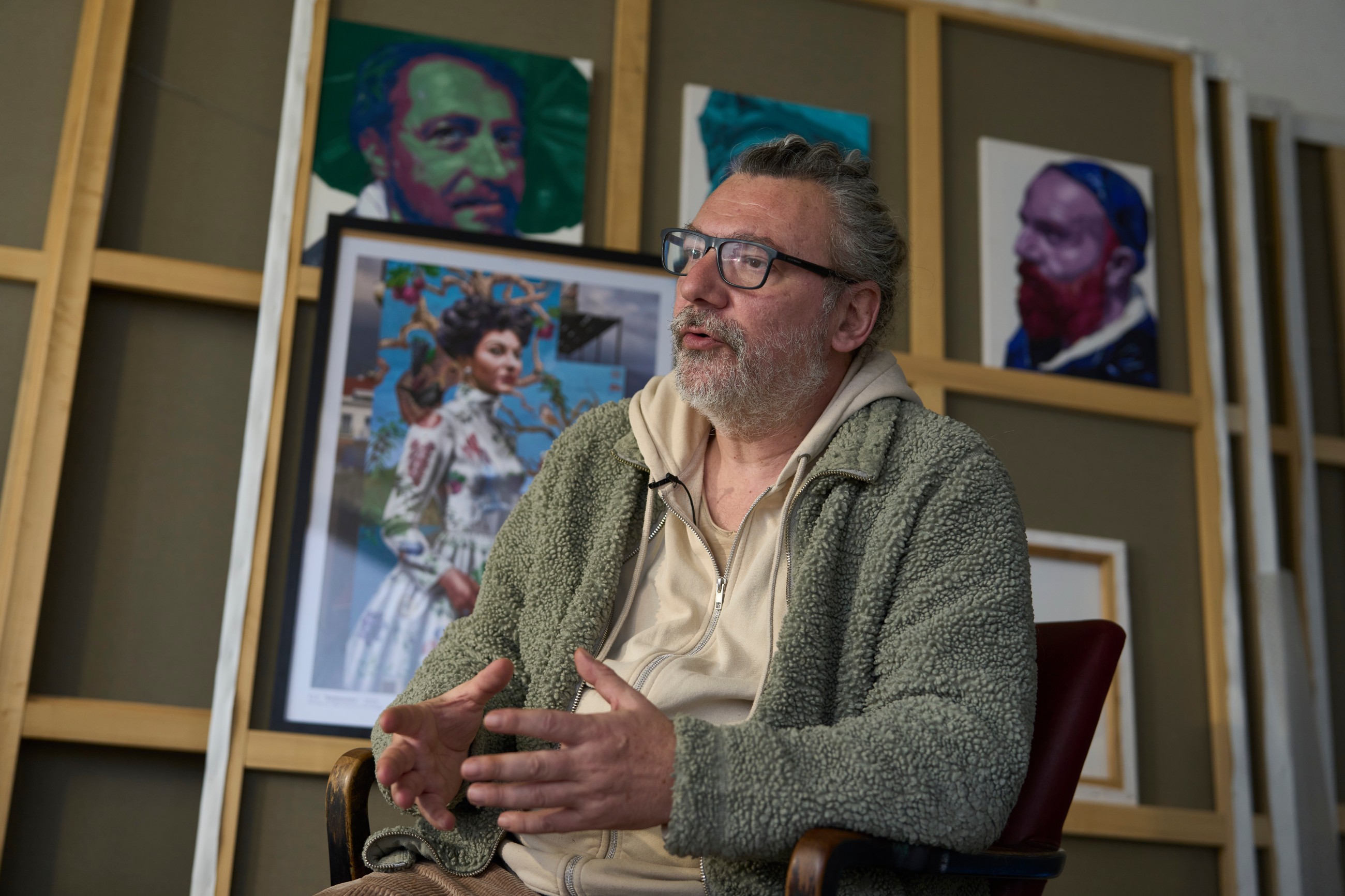
Artist Kleomenis Kostopoulos, 52, said the mural “is not actually called ‘Maria Callas,’ but ‘Kalamata’ and my attempt was to paint Kalamata (the city) allegorically.” Rather than portraying a stylized image of the diva, Kostopoulos said he aimed for a more grounded and human depiction. He incorporated elements that connect the people to their land: tree branches — which he considers the above-ground extension of roots — birds native to the area, and the well-known agricultural products. “The dress I create on Maria Callas in ‘Kalamata’ is essentially all of this, all of this bloom, all of this fruition,” he said. “The blessed land that Kalamata itself has ... is where all of these elements of nature come from.”
Creating the mural was no small feat. Kostopoulos said it took around two weeks of actual work spread over a month due to bad weather. He primarily used brushes but also incorporated spray paint and a cherry-picker to reach all edges of the massive wall.
Papaefstathiou, the deputy mayor, said the mural has become a focal point.
“We believe this mural has helped us significantly in many ways, including in strengthening the city’s promotion as a tourist destination,” he said.
Beyond tourism, the mural has sparked conversations about art in public spaces. More building owners in Kalamata have already expressed interest in hosting murals.
“All of us — residents, and I personally — feel immense pride,” said tourism educator Dimitra Kourmouli. Kostopoulos said he hopes the award will have a wider impact on the art community and make public art more visible in Greece. “We see that such modern interventions in public space bring tremendous cultural, social, educational and economic benefits to a place,” he said. “These are good springboards to start nice conversations that I hope someday will happen in our country, as well.”
Meanwhile, Greece said on Monday it will try to obtain photos that appear to show the final moments of 200 Greeks who were executed by a Nazi firing squad in Athens during World War II, after the previously unknown pictures appeared on an online sale site. The images that appeared on eBay over the weekend allegedly show the men being led to their deaths on May 1, 1944, at a shooting range in the Kaisariani suburb of the Greek capital. Although the executions were well known, there were no known photos or film documentation of the event.
Greece’s Culture Ministry said on Monday that “it is very possible that these are authentic photographs,” adding that it will seek to obtain them as historical archives after they were put up for sale on Saturday by a collector in Belgium of German military memorabilia. The series of pictures show men being led through a gateway and down a path. They stand straight as they are lined up in front of a wall. The Kaisariani executions of 200 communist political prisoners were one of the worst atrocities during the Third Reich’s occupation of Greece and remain a seminal moment for the country. As World War II ended, a vicious civil war between Western-backed government forces and communist fighters broke out and lasted until 1949. Its wounds have still not entirely healed.
Associated Press