Oregon artists transform vinyl records into messages of Black resilience
- Last updated: February 11, 2026 | 10:54


Medford: It takes time to absorb all the social justice messages in “The Soundtrack of Black Resistance,” an 18-foot-long artwork created by children and exhibited at the Rogue Gallery & Art Center in Medford. Vinyl records, which few of the youth knew existed long before digital streaming services, were painted with abstract images over the spiral grooves and original words on the center label. The 40 discs were then fixed to an unprimed canvas. Over time, the records were surrounded by red, black and green handprints and lyrics selected by the children who participate in programs offered by the Black Alliance & Social Empowerment (BASE) Southern Oregon organization in Medford.
Lyrics penciled on the canvas include classics originally released only on vinyl, like singer Nina Simone’s anthem “To Be Young, Gifted and Black” and James Brown’s “Say It Loud – I’m Black and I’m Proud.” The youth also found inspiration in new songs by Beyonce to Alicia Keys. The wall-long artwork is part of BASE‘s larger exhibition, “Roots, Rhythm, and Revolution,” which runs through Feb. 27. This is the third year BASE has curated an exhibition at the Rogue Gallery as part of its Black Cultural Legacy Series celebrating Black History Month.
Throughout February, organizations across Oregon will host concerts, film screenings, exhibitions, lectures and community workshops highlighting Black history, creativity and scholarship. BASE founder and executive director Vance Beach said the “Roots, Rhythm, and Revolution” exhibition was thoughtfully named.
“Part of understanding where you’re headed is knowing your roots, where you came from,” he said. “Being in rhythm with each other is unifying and revolution is the action.”
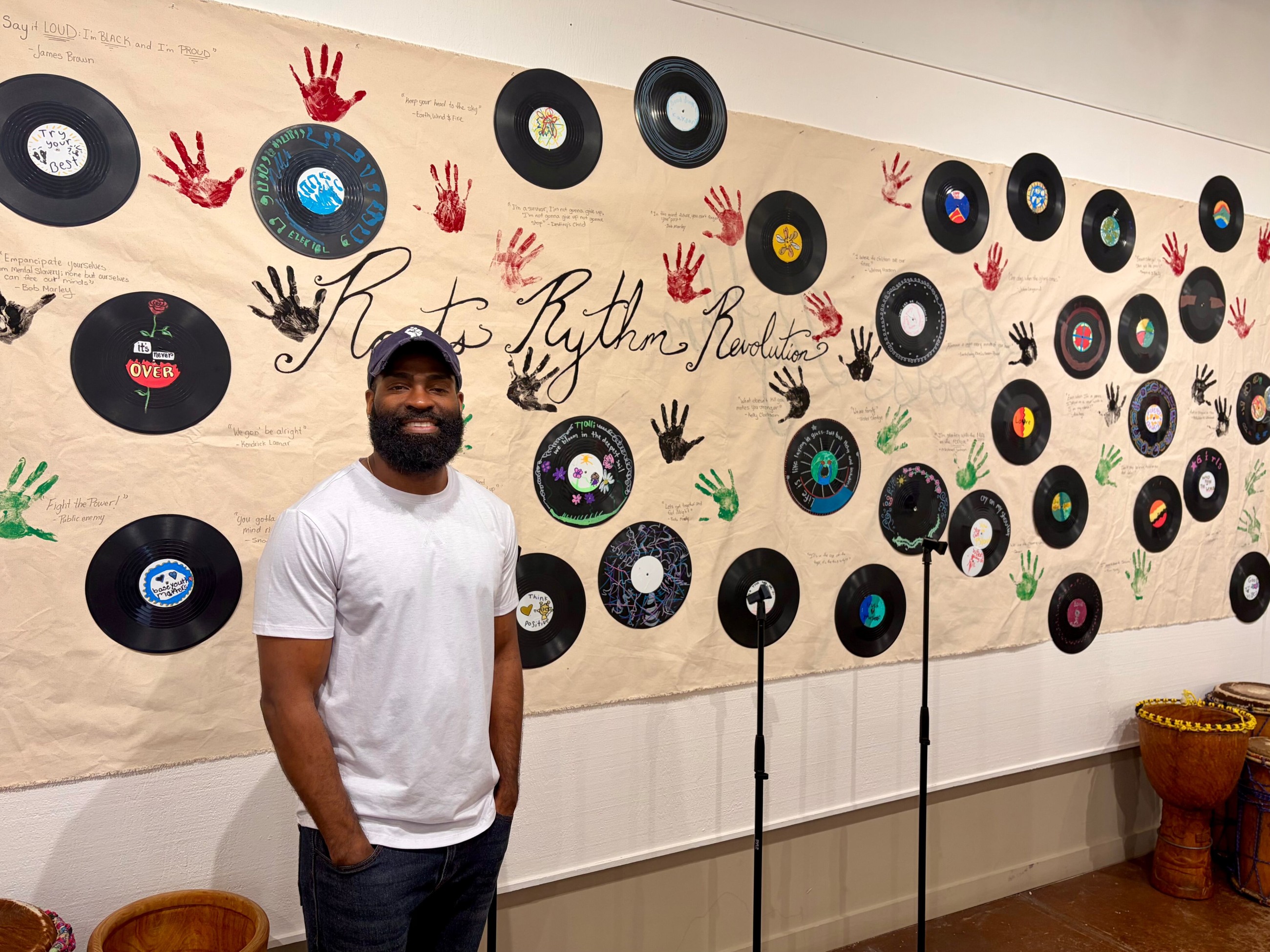
Djembe drums modelled after ancient instruments that originated in Africa rest on the floor underneath “The Soundtrack of Black Resistance.” The drums express “the heartbeat of the people,” said Beach, and evoke discussions on historic laws that made the musical instruments illegal as a form of cultural suppression. Enslavers feared the instruments could be used to send messages over long distances and unite people, according to historians. Alternative drum-like sounds made by clapping, stomping and patting the chest or thighs are foundational to modern blues, jazz, soul and gospel.
BASE created the Black Cultural Legacy Series because Beach and others see culture not as an extra element of society but as infrastructure. “When Black youth and families can see themselves reflected with dignity, it strengthens belonging, confidence and community wellness,” Beach said.
The “Roots, Rhythm, and Revolution” exhibition curated by Beach includes hundreds of works of art by BASE participants and community members.
One of the artists, Hakiym Sha’ir, also known as Brian Simpson, is an imprisoned wildland firefighter who contributed poems and a painting. Simpson was convicted in August 2024 in Josephine County Circuit Court for second-degree assault for his role in a fight with a fellow firefighter.
“Art is a channel for him,” said Beach, adding that BASE members have been working with Simpson’s lawyer to petition Oregon Gov. Tina Kotek to have the firefighter released from his six-year prison sentence.
BASE received a grant last year from the Oregon Cultural Trust supporting the nonprofit organization’s year-round youth programs, social connections and celebrations for MLK Day, Malcolm X‘s birthday, Juneteenth and Kwanzaa.
The organization’s Cultural Trust grant also helped fund Ashland artist Crystal Proffitt’s installation “Don’t Touch My Hair: An Interactive Crowned Experience,” which debuted Jan. 3 at Langford Art Gallery in the Rogue Valley city of Phoenix.
As planned, when Proffitt’s well-attended solo show in Phoenix closed on Jan.24, her installation was dismantled with intention, transported and reconfigured to join BASE’s exhibition in the main gallery at the Rogue Gallery. In the multi-sensory “Don’t Touch My Hair“ installation, visitors touch the arranged strands of hair attached to six portraits of Black models while listening to voice recordings of the models speaking about styling hair.
One model called hair “my soul signature” and others speak of ancestral acts of cultural identity, healing and resilience.
The models also talk about uncomfortable experiences of strangers scrutinizing, questioning and reaching for their hair.
Proffitt collaborated with photographer Ally White and Afrofuturist multimedia artist Micah Blacklight to create the portraits. The portraits surround a sculptural, 6-foot-tall Ancestor Tree equipped with a light system by engineer and artist Robert Quattlebaum of Voria Labs.
Proffitt said it was important to exhibit her art in a gallery setting to allow for critical reflection on the beauty of often-maligned textured hair and how histories of exclusion continue to shape contemporary experiences.
Beach said Proffitt’s work is “important, timely and beautifully executed” as both art and education.
“‘Don’t Touch My Hair’ holds a mirror up to the world and invites something better: respect, cultural understanding and care,” Beach said. “We’re proud to help bring this experience to southern Oregon, and we hope people come with curiosity, care and a willingness to grow.” Kristen O’Neill, executive director of Rogue Gallery & Art Center, said a few of Proffitt’s paintings were exhibited at the Medford gallery last February during BASE’s 2nd annual Black Cultural Legacy Series. “It’s wonderful to celebrate Crystal and the recognition she is receiving,” said O’Neill, who sees the gallery’s mission as creating community connections and providing a safe place for expression.
“There is a relationship between artist and artwork and viewer, and that layer of communication flows back and forth,” said O’Neill, who is also an artist.
When people slow down to experience self-expression and communication through visual arts, music, dance or storytelling, O’Neill said, “conversations can find common ground and a new vision for who we are as a people.”
Tribune News Service