What’s like got to do with it? Author Sara Levine on the art of ‘difficult’ women
- Last updated: February 8, 2026 | 10:30


The other day the author Sara Levine asked me to meet her at a dog beach in Evanston. I didn’t have a hard time finding her. She said she would be wearing an orange cap and she was. The problem — and here is where I felt as though I slipped suddenly into a Sara Levine novel — was that the beach was padlocked and Levine arrived without her dog. Also, at the very moment we met, Northwestern University’s Emergency Notification System began to boom out a test, which sounds like a tornado siren with the addition of a deep male voice imploring you to stay calm, no emergency is occurring.
In a Sara Levine novel — and so far, she’s only written two in 25 years — the heroine would likely take that as a sign, like some kind of cosmic irony that an emergency was definitely occurring. Levine suggested we meet at a dog beach because “The Hitch,” her new novel — her first since “Treasure Island!!!,” Levine’s beloved 2012 cult classic — centres on a dog attack in Evanston that leaves a corgi dead and a 6-year-old boy certain he’s possessed by the dead dog’s soul. But like “Treasure Island!!!,” it’s also funny and unhinged and so relatable you wonder if Levine, who chairs the writing department at the School of the Art Institute of Chicago, has been slowly making a case for the lost art of the literary comedy novel.
Indeed, Levine’s characters are so queasily recognisable, this wasn’t even the first time in recent months that I felt as if I had stepped unwittingly into a Sara Levine story. By some twist of completely off-the-wall fate, the same week I was reading an early copy of “The Hitch,” I was bitten several times by a dog. Seriously. It was bonkers. I was walking through a restaurant patio on the North Shore and a dog launched itself onto my calf like I was sirloin. My first thought: Why me? I felt like that guy in a movie who hasn’t yet become a werewolf but all of the neighbourhood dogs know he’s a werewolf and start barking. And yet, it wasn’t even the dog attack that reminded me of Levine — it was the way diners glared at me, as if I interrupted their burgers. I felt a weird shame.
When I told Levine this — and that I was not that excited to hang out at a dog beach anyway, considering — she told me about the attack in Evanston that led to “The Hitch.”
“So I was walking my dog by (Evanston Township High School) and he’s a little goldendoodle and this dog — no leash, but with a pink collar — suddenly appears in the alley. It’s a pit bull. I’m not anti-pit bull and I don’t mean to stereotype. She’s a little pit, but pits do have strong jaws and she attacks my dog. This was 2020. I have these horrible voice memos with my dog wailing. Anyway, now I’m in a crisis, and what am I doing to do? I’m terrible in a crisis. I also don’t want to hurt the other dog. If I let my dog off the leash he might get hit by car, so I’m frozen there, and I’m also trying to separate them, but I’m also thinking I can’t kick this dog — even with what’s happening in front of me, I couldn’t do it. The house on the corner has a Newfoundland standing in the yard, and the woman at the house sees me. She tells me to run for her car, but it’s actually a truck with a flatbed. She grabs a shovel and starts swinging at the dog, and my legs at this point are jelly but we make it into the flatbed and the pitbull is just launching itself at us, just like Cujo. My first thought was, Did I make this happen? I had started writing about a dog, so: Did I bring this on? That’s nutty, but it’s how you feel at times when things happen.”
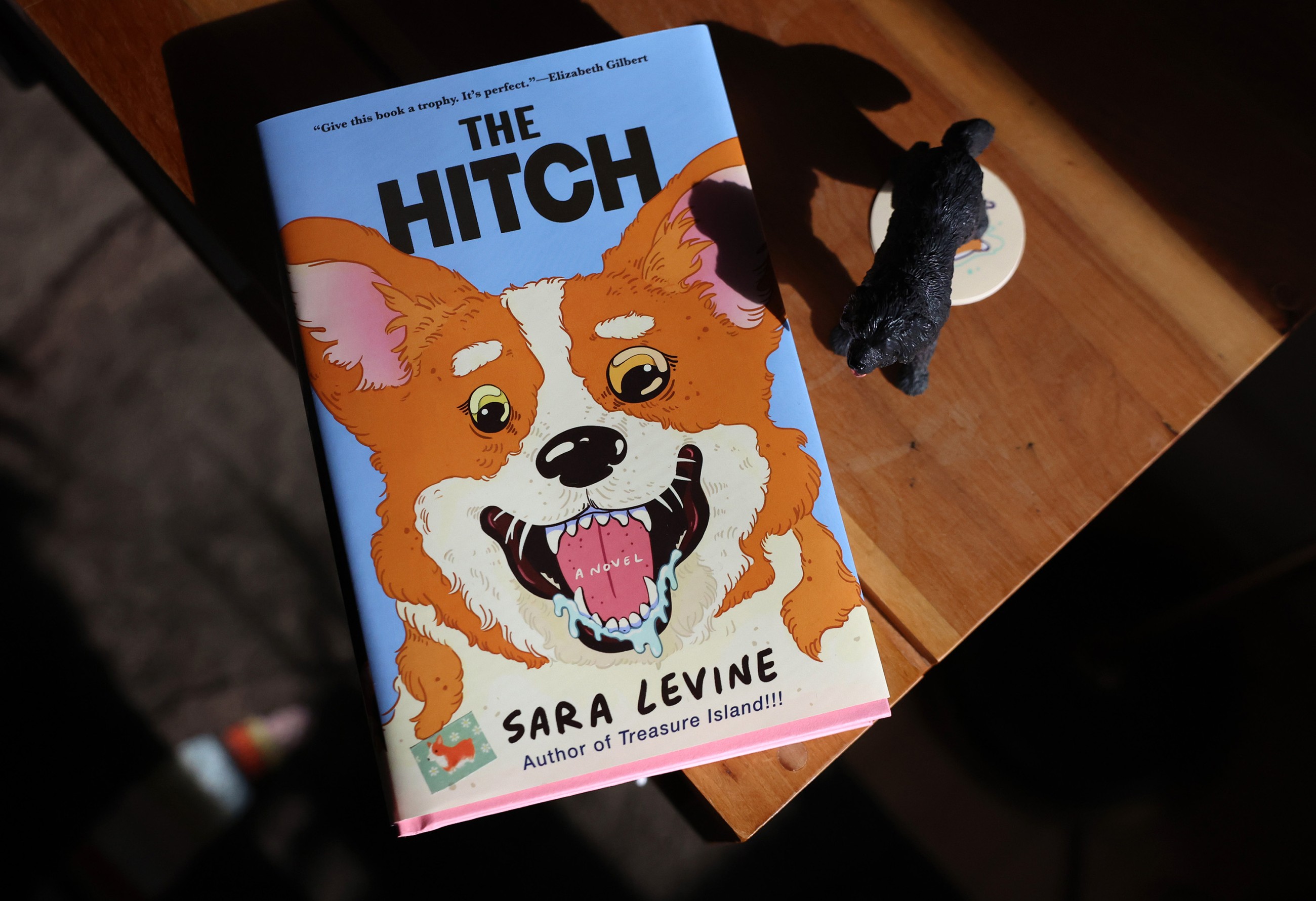
Levine’s novels feel right for early January, for this gray period when we’re all expected to reassess our lives, make changes and emerge in the spring with clearer heads. The way certain works of fiction can do, her books could double as perverse self-help, starring heroines who go out of their ways to show how not to conduct your life. Her writing voice, sardonic, breezy, chimes with Joy Williams and Donald Barthelme, but it’s hard not to hear “Curb Your Enthusiasm” and even “The Office” — that nexus where unraveling people lacking self-awareness stumble across empathy.
The heroine of “Treasure Island!!!” — a 25-year old clerk of a “pet library” — reads Robert Louis Stevenson’s legendary adventure and quickly reassess her narrow timid life, deciding there and then to live by a credo culled from Stevenson: Boldness, Resolution, Independence, Horn-blowing. But by the end, she kills a parrot and is so obsessed with “Treasure Island,” family and friends stage an intervention between her and the novel. The heroine of “The Hitch” could be related, if only tangentially: Her name is Rose Cutler and she is an Evanston yogurt company CEO (as well as “antiracist, secular Jewish feminist eco-warrior”). Rose is also perilously up her own keister. She does not want children (“not for one atom-spitting second”) but she is never so shy with opinions about the way her brother and sister-in-law raise their own kid. When they go on vacation, Rose jumps at the chance to play aunt for a week — which is when the dog attack occurs, her nephew decides (cheerfully) the dog’s soul leapt bodies, and worse.
Rose is a micromanager, and lousy in a crisis. It spoils nothing to say the closest she gets to enlightenment is a brief ah-ha: “Sometimes my mind gets active as a prairie dog and I build elaborate tunnels underground, room after room of judgement and justification.”
The writer Roxane Gay— who once included Levine’s work in an essay on unlikeable women characters (“Not Here to Make Friends”) — said that just after she landed her own imprint (Roxane Gay Books) at Grove Atlantic, she sought out Levine and asked what she was working on: “It had been some time since ‘Treasure Island!!!’ and Sara did not disappoint. The writing voice I fell in love with was still there, but she had grown, and though this Rose character was older, you’re reminded that sometimes we don’t really outgrow our lesser selves — that sometimes we just learn to live with them, you know?”
Levine told Gay that not every reader is a fan of unlikeable woman characters. She told Gay about the (smallish) subset of Goodreads reviewers who describe her women as “utterly unlikeable” and “irredeemable.” Gay told me, “I don’t know why writers are so willing to expose themselves to Goodreads. Some people have a parasocial relationship with book characters, and it meets a puritanical streak where people decide they don’t like a character who is a ‘bad person,’ forgetting flawed people exist. Rose is convinced she knows the right way to do things and her ethics are in the right place — bless her heart.”
Tribune News Service