Saif Azzuz underlines significance of water in UAE life at Lawrie Shabibi
- Last updated: January 5, 2026 | 10:29


Muhammad Yusuf, Features Writer
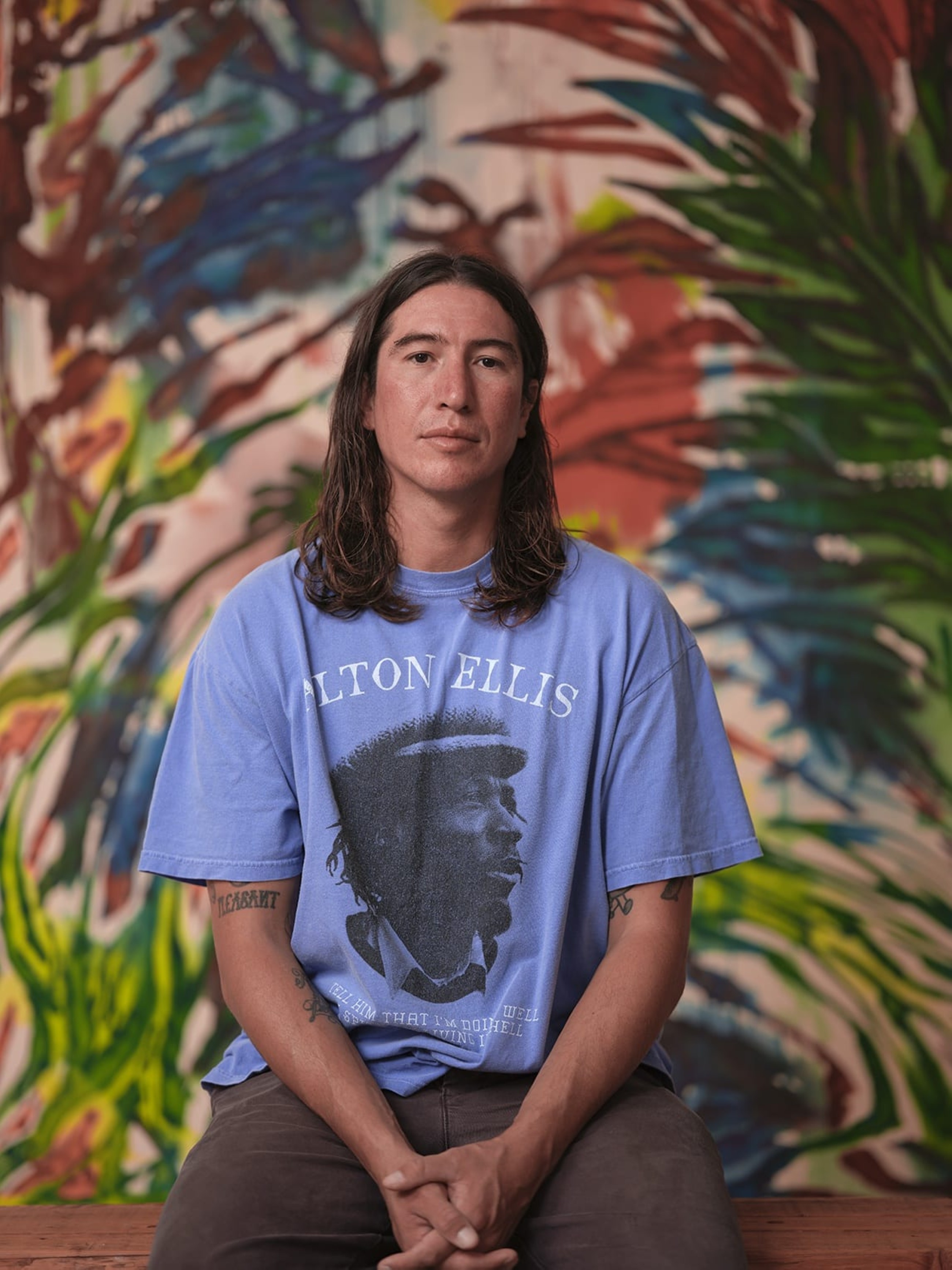
Lawrie Shabibi, Alserkal Avenue, is presenting Invisible Fish by Saif Azzuz, opening January 17. It marks the artist’s first solo exhibition in the Middle East. The exhibition brings together painting, works on paper, sculpture and moving image, tracing an ecological and cultural history of the region, prior to large-scale urban development. A Libyan–Yurok artist based in San Francisco, Azzuz approaches land and water as lived, relational systems rather than extractive resources, foregrounding marine environments, fishing practices and water, as both sustenance and connective force across geographies.
An AI Overview notes that Yurok are a Native American people indigenous to northwestern California, living along the Klamath River and Pacific coast, known as expert fishermen, weavers, and canoe makers, with a rich culture centered on salmon, acorns, and deep stewardship of their redwood forest lands, maintaining traditions and a distinct language (Yurok). Their name means “down the river”.
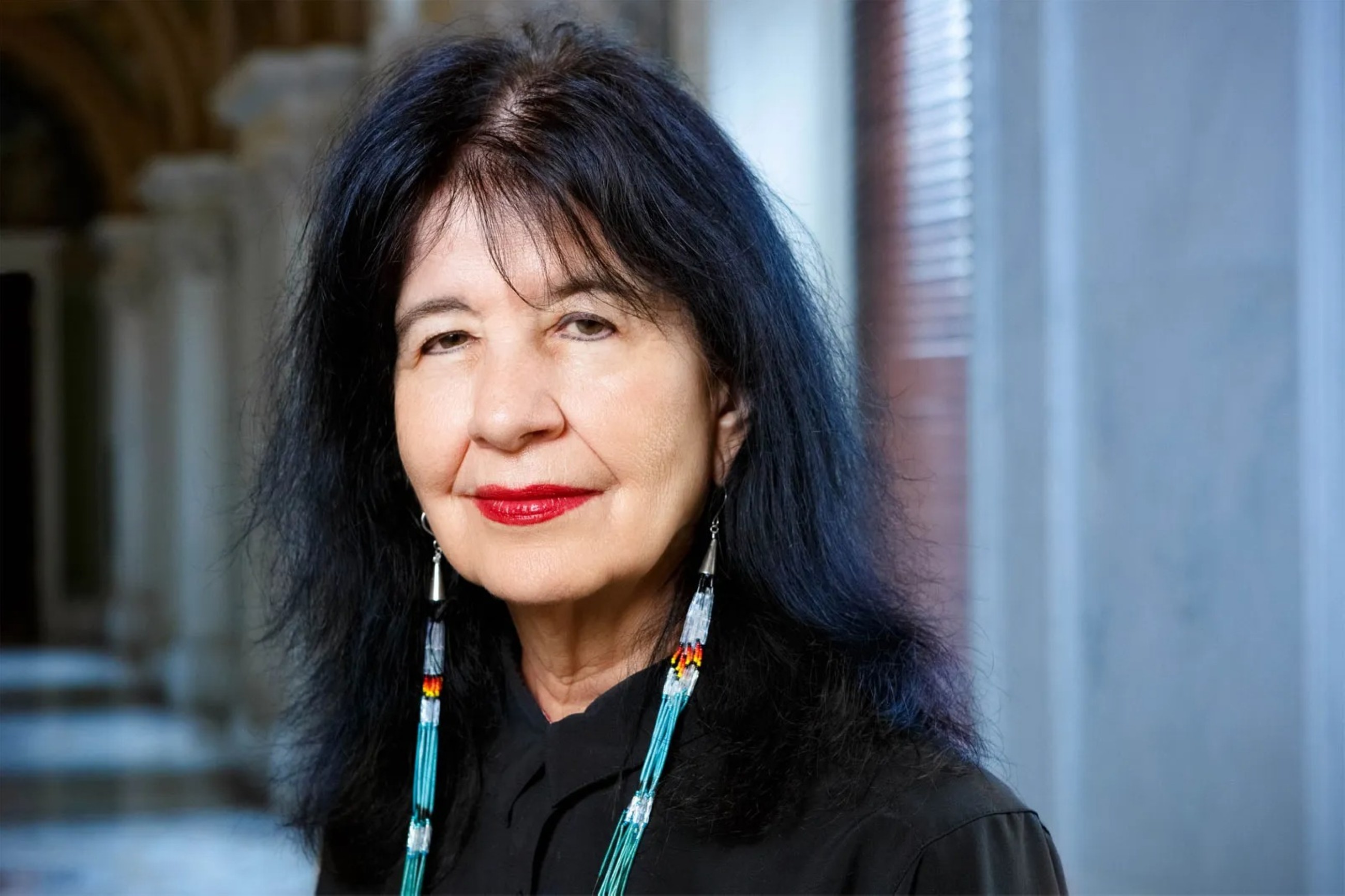
The exhibition title, Invisible Fish, is drawn from the poem of the same name by Joy Harjo, which Azzuz was reflecting on while conceiving the works in the exhibition. Harjo’s text traces cycles of transformation across land, water and time, moving from submerged worlds to human habitation and industrial presence, which resonates with the exhibition’s focus on ecological change, ancestral memory, and the layered histories embedded within landscapes shaped by both natural forces and human intervention. The poem reads:
“Invisible fish swim this ghost ocean now described by waves of sand, by water-worn rock./Soon the fish will learn to walk./Then humans will come ashore and paint dreams on the dying stone./Then later, much later, the ocean floor will be punctuated by Chevy trucks, carrying the dreamers’ descendants, who are going to the store.” Harjo (b. 1951) is an American poet, musician, playwright, and author. She served as the 23rd United States Poet Laureate, from 2019 to 2022 and was the first Native American to hold the honour.
Azzuz’s practice is informed by sustained research into the coastal landscape of the UAE, when fishing villages and maritime labour shaped everyday life and subsistence. His work reflects on these inherited relationships to water, while addressing the environmental transformations brought about by rapid development. Across the exhibition, the marine ecosystem emerges not as a backdrop but as an active agent, fragile, adaptive and deeply entangled with human activity. Central to the presentation are the Algae Bloom paintings, in which Azzuz adopts a process-driven approach to evoke underwater environments through movement, layering, and material flow.
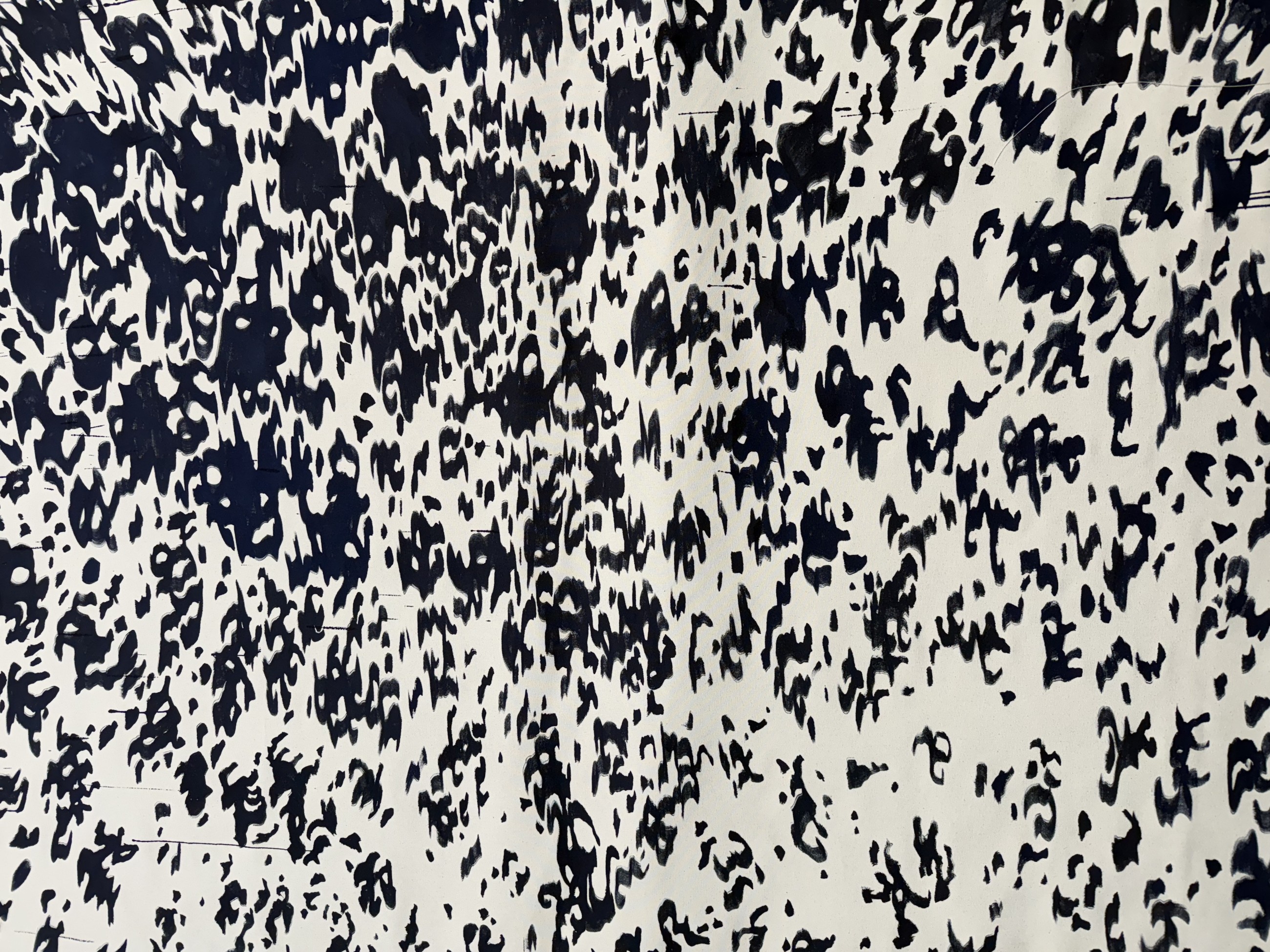
Working wet-on-wet, he allows paint to bleed, drip, and merge, producing organic forms that feel suspended and continuously evolving. Vertical runs and interwoven marks suggest growth patterns found in marine plant life, while areas of openness create depth and circulation. Rather than literal depictions, the works function as sensory impressions of aquatic ecosystems shaped by rhythm, fragility, and transformation. Another series of paintings draws from fish species found in and around the waters of the UAE, translating their distinctive scales into abstract, rhythmically patterned surfaces.
Titled Friend of Hamour, Hamour, Chinook, and Rainbow Trout, the works move away from figuration to focus on texture, repetition, and surface memory. Enlarged scale-like forms are rendered through layered mark-making, where density and variation evoke protective skins while also recalling geological or cellular structures, positioning marine life within broader systems of natural patterning.
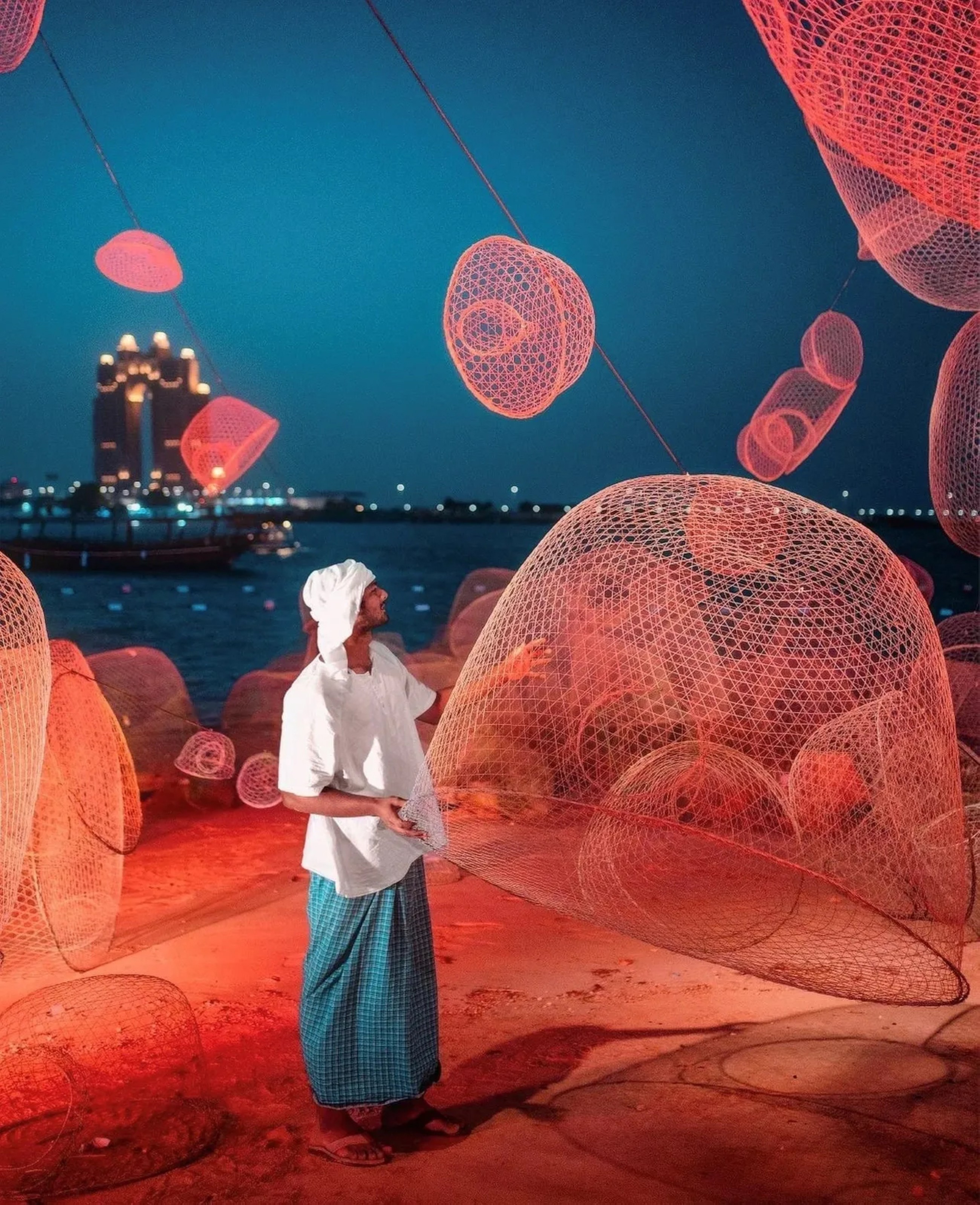
The installation What’s a Pedagogy? I’m Trying to Eat is composed of gargour fishing traps, drawing on a practice deeply embedded in the UAE’s maritime history. Traditionally used by local fishermen, the gargour is re-contextualised as both a functional object and a cultural marker. Beyond their role in fishing, the traps are sometimes left submerged after use, where they become sites for coral growth and marine regeneration.
Water also operates as a connective thread across geographies central to the artist’s life. In the three-channel film installation In an Invented Summer the World Breaks Apart, Azzuz brings together bodies of water from San Francisco, the Yurok Reservation along the Klamath River, and the coastal waters of Dubai.
Positioned side by side and visually aligned, the scenes form a continuous horizon, collapsing geographic distance and presenting water as a unifying presence shaped by memory, movement, and lived experience. Together, the works in Invisible Fish articulate a sustained reflection on marine environments as sites of memory, labour, and ecological interdependence. Through material experimentation and research-driven enquiry, Azzuz positions water not only as a subject, but as a shared condition — one that links place, history, and the ongoing negotiation between human activity and the natural world.
Saif Azzuz’s works are held in public collections like Blaffer Art Museum; University of St. Thomas, St. Paul; Rennie Museum, Vancouver, British Columbia; de Young Museum – Fine Arts Museums of San Francisco; KADIST, San Francisco; META, Menlo Park, CA; North Carolina Museum of Art; Gochman Family Collection; Stanford Health Care Art Collection; and UBS Art Collection. Lawrie Shabibi is a contemporary art, supporting the long-term development of the careers of young international contemporary artists, with a focus on those from the Middle East and North Africa. It also works with older generations of artists from the region. The gallery has successfully introduced international artists to the region, while presenting Middle Eastern artists to the international contemporary art community. Its years old regular programme of exhibitions, screenings and talks, publishing catalogues and participation in international art fairs, makes it a forerunner in the development of the contemporary art scene in Dubai.