UAE economy grows by 3% in Q1 driven by strong non-oil sector
- Last updated: August 4, 2026 | 14:21


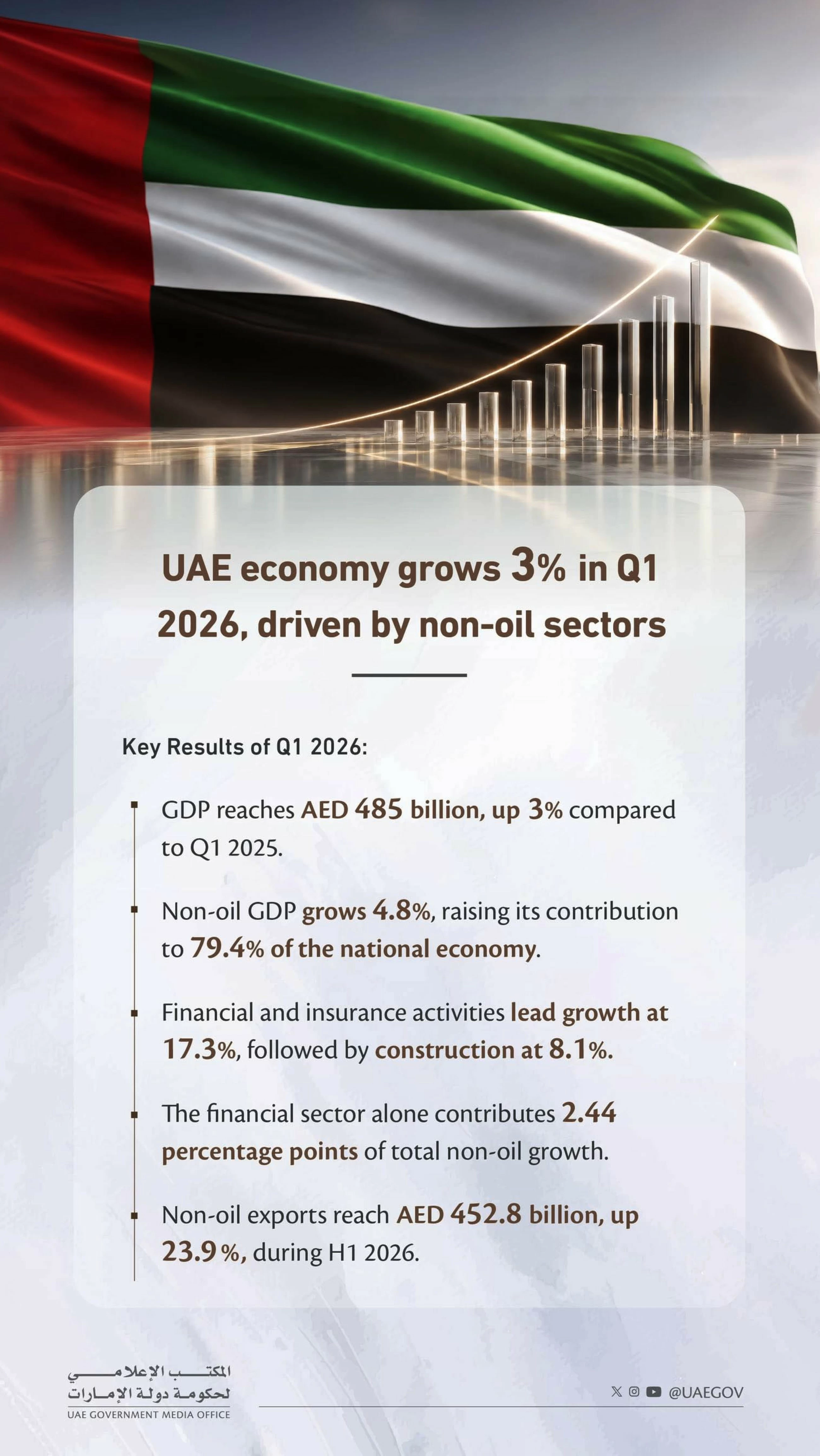
The UAE's real gross domestic product grew by 3 per cent in the first quarter of 2026 to reach Dhs485 billion at constant prices, while non-oil GDP grew by 4.8 per cent, raising its contribution to 79.4 per cent of the national economy.
The figures reflect the continued strength of non-oil economic activities and the resilience of the national economy despite the regional challenges witnessed during the first quarter, whose impact was confined to a limited number of activities and did not affect the overall trajectory of economic growth.
Data from the Federal Competitiveness and Statistics Centre showed that the contribution of non-oil activities to GDP increased to 79.4 per cent in Q1 2026, compared with 78.0 per cent in 2025, underscoring the effectiveness of the UAE's economic diversification policies and progress towards the objectives of the "We the UAE 2031" Vision.
Mohammad Bin Abdullah Al Gergawi, Minister of Cabinet Affairs, said the results reflected the success of development policies aimed at increasing the contribution of non-oil sectors to the national economy.
He said, "The Q1 2026 results reflect the ability of the UAE's government work system to translate the wise leadership's strategic vision into tangible economic results that serve people and the future.
"The growth led by the non-oil economy — through sectors such as finance, trade, and information, technology and communications, which contributed significantly to non-oil GDP growth in the first quarter of 2026, raising its contribution to 79.4 per cent — is not an isolated figure, but the outcome of integrated government policies and initiatives working as one system towards one goal: consolidating the UAE's standing as a global leader in competitiveness, excellence and future readiness."
"We continue to work with our partners in the government and private sectors to ensure that economic performance remains a true reflection of the quality of life and the opportunities the UAE provides for its citizens, residents and investors from around the world," he added.
Financial and insurance activities led economic growth, expanding 17.3 per cent year-on-year, followed by construction at 8.1 per cent, human health and social work activities at 7.7 per cent, information and communication at 5.9 per cent, and professional, scientific and technical activities together with administrative and support services at 4.9 per cent, reflecting continued momentum across vital, high-value-added economic activities.
Real estate activities grew 4.8 per cent, public administration, defence and compulsory social security rose 4.5 per cent, while wholesale and retail trade expanded 2.6 per cent, reflecting the broad-based nature of economic growth.
In terms of their actual contribution to growth, financial and insurance activities made the largest contribution, accounting for 2.44 percentage points, followed by construction with 1.04 percentage points, wholesale and retail trade with 0.42 percentage points, real estate with 0.36 percentage points, and professional, scientific and technical activities together with administrative services with 0.29 percentage points.
Abdulla Bin Touq Al Marri, Minister of Economy and Tourism, said the results reflect the robustness of national economic performance and its ability to sustain growth.
He said, "The results of the first quarter of 2026 reflect the robustness of the national economy's performance and its ability to sustain growth and enhance its competitiveness at both the regional and global levels, embodying the success of the vision and directives of the wise leadership, as well as the policies and legislation adopted by the country to advance economic diversification.
Al Marri stated, "Non-oil sectors continue to lead growth, raising their contribution to 79.4 per cent of GDP, supporting the UAE's sustainable economic growth and reinforcing its position as a global hub for business and investment."
He added that the strong performance of non-oil sectors confirms the resilience and competitiveness of the UAE's business environment, which has continued to develop over recent years. This performance also reflects the country's vision of transitioning towards a more diversified and sustainable economic model, capable of adapting to global developments and sustaining its growth trajectory, in line with the objectives of the 'We the UAE 2031' Vision, which seeks to double the size of the national economy to Dhs3 trillion by 2031.
The strong performance of non-oil sectors is consistent with the UAE's expanding foreign trade, supported by the network of Comprehensive Economic Partnership Agreements, which has opened new markets for national non-oil exports and strengthened manufacturing, trade and logistics activities.
Dr. Thani Bin Ahmed Al Zeyoudi, Minister of Foreign Trade, said, "The UAE's GDP growth results for the first quarter of 2026 reflect the success of the wise leadership's vision in continuing to build a more open and globally competitive economy. It confirms the soundness of the approach based on expanding trade and investment partnerships and strengthening the UAE's integration into the global economy through the Comprehensive Economic Partnership Agreements programme.
"This opens new horizons for growth, reinforces the UAE's position as a global gateway for world trade, and enhances the country's attractiveness to high-quality investments."
Al Zeyoudi added, "This approach is clearly reflected in the record performance of non-oil foreign trade, as the Comprehensive Economic Partnership Agreements continue to open new markets for UAE exports of goods and services, supporting the growth of non-oil sectors, increasing their contribution to GDP and advancing sustainable economic development.
Non-oil exports grew by 23.9 per cent during the first half of 2026 to reach Dhs452.8 billion, recording the highest growth rate among the components of the UAE's foreign trade, which confirms the pivotal role of trade openness in stimulating domestic production and enhancing the competitiveness of the industrial and services sectors as among the country's most important drivers of economic diversification.
As part of the comprehensive transformation of the national statistical system, the UAE is currently undertaking a comprehensive revision of its GDP accounts, including the integration of new data sources, the incorporation of free zones within the scope of statistical coverage, and the alignment and harmonisation of methodologies in line with international standards and best practices to enhance the accuracy and comprehensiveness of economic measurement.
The announced results are based on the current statistical methodology, and the time series will be updated in line with the outputs of the Comprehensive GDP Revision Programme upon its completion.
The programme is being implemented in partnership and technical coordination with a number of specialised international institutions and organisations, ensuring that methodologies are aligned with the best international standards and practices to enhance the reliability and comparability of the results.
WAM